
Your needs, this model
Does it fit your priorities?
Can you work with one compatible flat pan at a time on an indoor household counter?
Aroma’s AID-510 manual documents one marked cooking circle, iron-containing induction cookware and a level, dry, heat-resistant indoor surface at 120 V AC. It does not give a pan-base diameter. This support-only identity is useful for an existing unit, not a current purchase pick.
Explore this need in the finder →Would an eight-hour general/Slow Cook timer and shorter preset limits fit your routine?
General heating and Slow Cook can be timed up to eight hours; Boil reaches one hour and Sauté/Brown 20 minutes. General heat, Slow Cook and Boil return to Warm at expiry, but Sauté/Brown shuts down.
Explore this need in the finder →Are named cooking shortcuts enough, or do you need a separate pan-temperature mode?
P1–P5 and Sauté/Brown, Boil, Slow Cook and Warm are not a separate measured pan-temperature range. If that feature is essential, the AID-510 manual does not confirm it; use a model with an exact documented Temperature Mode instead.
Explore this need in the finder →AROMA Forté AID-510: an owner’s reference, not a current buying pick
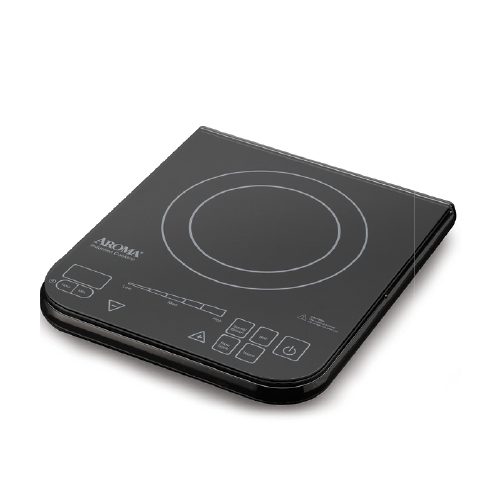
The Forté AID-510 is a one-zone household induction cooktop identified by Aroma’s model-specific parts-and-manual page and its linked instruction manual. That page is a support record, not an offer for the cooking appliance; this research did not establish an exact current or historical cooktop seller. Treat this review as a guide to an already-owned AID-510, not as a reason to buy a used unit or as proof that one is available. The manual’s copyright is 2013, but neither the document nor the support page confirms a present warranty or the condition of any surviving appliance.
Five numbered levels plus shortcuts on one cooking zone
The manual describes five heat settings, from P1 at Low through P5 at High. It also gives the AID-510 separate Sauté/Brown, Boil, Slow Cook and Warm controls. Those are alternate routines on the same marked cooking circle, not extra burners or a second temperature-controlled surface. The soft-touch panel has an LED display, hour and minute keys, and up/down adjustments. That combination can be convenient when a household repeats the same kind of task, but the manual does not provide a watt-by-watt map for P1–P5. It says the temperature reached depends on the food and cookware, so the numbered steps are not measured pan temperatures.
The named shortcuts are not interchangeable timers. Sauté/Brown can be set from one to 20 minutes and shuts the unit off when its time expires. Boil runs from one minute to one hour, then returns to Warm. Slow Cook is adjustable from one to eight hours and also changes to Warm at the end. The manual’s general cooking timer reaches eight hours; at expiry that routine switches to Warm. Warm has no programmable duration and shuts itself off after eight hours. Aroma says Warm is for holding food that is already fully cooked, not for cooking a raw dish. If your recipe needs a particular surface temperature, this model’s five heat levels and shortcuts do not establish that capability.
Cookware and electrical fit need a little checking
The AID-510 needs an induction-ready pan with iron in its base. Aroma lists cast iron, enameled cast iron, magnetic stainless steel and magnetic anodized aluminum as suitable material types; its manual says plain aluminum, copper and glass will not work. It instructs the user to center the pan over the printed cookware circle. A magnet test helps establish whether a pan is magnetic, but the manual supplies no minimum or maximum base diameter. The support page’s image shows the cooktop, not an included pan, and the exact model record does not establish a cookware bundle. If your regular pan is unusually small or wide, verify fit with the actual unit rather than judging by the photo.
The manual specifies 120 V AC and a polarized two-blade plug. It does not name a NEMA plug type or state current, wattage, frequency, or a required branch-circuit rating. Those gaps matter if you need a particular plug or have a strict electrical limit; do not fill them with figures from another Aroma model. The manual calls this a household appliance, asks for a level, dry, heat-resistant surface, and says not to use it outdoors. No body dimensions, cord length or weight are supplied, so measure the unit itself before deciding where it will fit.
Operation and care are simple, but not silent or cool to the touch
The induction system will not start without compatible cookware centered on its circle. If a pan is removed during cooking, the cooktop stops heating and can beep for up to 30 seconds before shutting down. Aroma notes that the cooling fan may sound fairly loud but gives no sound measurement. The glass surface can remain hot after cooking even though induction primarily heats the pan. Unplug the appliance and let it cool before wiping the glass and controls with a soft damp cloth; clean sugary spills promptly and avoid immersion, abrasive pads and a rigid brush.
The manual includes a one-year limited U.S. warranty tied to a provable purchase date. That dated wording is not a promise of current coverage for an old, stored or secondhand unit. For an owner, the useful decision is whether the AID-510’s single zone, five heat steps and mode-specific timer behavior fit an existing routine. For a new purchase, compare exact currently offered models instead. If separate temperature settings are essential, the Duxtop 9600LS assessment documents a different one-zone model with a Temperature Mode; if you need two pans at once, look for a true dual-zone design. Read Aroma’s AID-510 support page and its linked instruction manual for the exact button sequence and safety details.
Key details at a glance
Use the exact model’s instructions for operating limits, supplied equipment and version differences.
Sources for this assessment

Choose for the cooking setup you will use.
Compare exact model controls, zone count, pan fit and operating limits—not only headline wattage.