
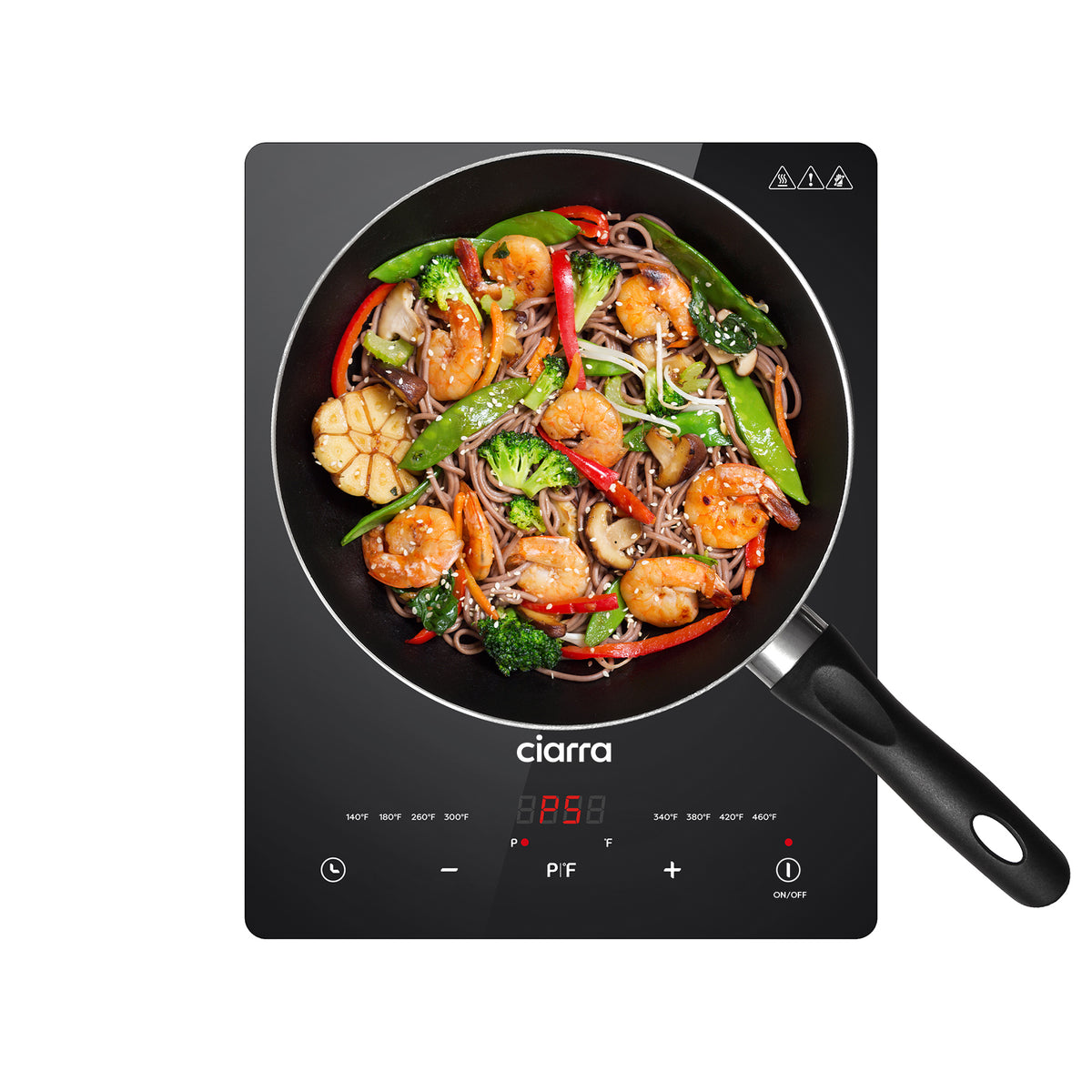
Your needs, this model
Does it fit your priorities?
Is one pan at a time enough, or must two zones heat together?
CATIH1-OW has one induction zone. It can meet a one-zone minimum but cannot satisfy simultaneous two-pan cooking.
Explore this need in the finder →Do you need a selectable power step at or below 100 W?
The linked CATIH1 manual lists a 100 W P1 step followed by 300 W, so a 100 W ceiling passes; the device does not offer every watt value between those steps.
Explore this need in the finder →Must the cooktop’s listed temperature mode reach at least 460°F?
The manual lists 460°F as its top Temperature-mode selection. It is a discrete cooktop setting, not a food-probe reading.
Explore this need in the finder →The Ciarra CATIH1-OW is a one-zone, 1,800-watt portable induction cooktop with two distinct control scales: nine Power steps beginning at 100 W and eight temperature selections from 140°F to 460°F. Its standout practical point is the 100 W starting step; several common countertop units start at 200 W. That can make the listed range more attractive for low-power routines, but nine discrete steps do not make a continuously adjustable simmer. This exact listing was marked sold out on the Ciarra US page when checked; its specifications and manual remain useful for evaluating the model, while availability through other sellers is not established here.
One pan with a low first power step
The model number on the product page is CATIH1-OW. The linked 12-page instruction booklet identifies itself only as CATIH1, so I treat it as a family-level operating manual rather than claiming the suffix is printed on the document. In that booklet, Power mode is a fixed sequence: 100, 300, 600, 800, 1,000, 1,200, 1,400, 1,600 and 1,800 W. The 100 W first setting is a real distinction from a 200 W-minimum model such as the Duxtop 8500ST. The steps then jump from 100 to 300 and from 300 to 600 W, so cooks who need small incremental adjustments should not mistake the low floor for fine gradation.
The separate Temperature mode offers 140, 180, 260, 300, 340, 380, 420 and 460°F. The intervals vary; the biggest gap is 80°F, between 180 and 260°F. This is useful when the listed setpoints matter more than a watt setting, but the manual does not describe a food probe or explain that the selected number is a measured pan or food temperature. Treat these as cooktop control choices, not as a replacement for a thermometer.
Pan fit, setup and a specification conflict
Induction requires a magnetic, flat pan base. Ciarra’s exact page feature text gives 4.7–10.2 inches; another technical row on that same page says 4.7–11 inches, while the CATIH1 manual allows a 4–11-inch pan bottom. Those ranges disagree. For planning, use the narrower page-feature interval rather than assuming every larger or smaller pan will work, and check the documentation that accompanies the exact unit if your cookware is near an edge. Measure the pan’s bottom, not its flared rim. The manual names cast iron, enamel and stainless steel as common compatible materials, and says aluminum, ceramic, copper, glass and Pyrex do not work unless the cookware has the required magnetic construction.
The product page lists a single 1,800 W zone, touch controls, a 13.4 × 10.63 × 2.36-inch body, 5.25 lb weight and 55-inch cord. Its electrical table is oddly broad—120–140 V and 50/60 Hz—whereas the manual instructs the user to plug into a 120 V outlet. The table’s 15 A entry is a fuse rating, not proof that a specific circuit is required. If voltage, frequency or circuit capacity is a hard constraint, confirm the rating plate on the individual unit instead of translating that fuse entry into a circuit claim. Ciarra lists a 24-month warranty on the page and manual; keep the purchase documentation and check the terms supplied with an offer.
Timer and household-use limits
The manual allows a one-minute-to-three-hour countdown. At expiry, the unit beeps and turns off automatically. It also reports an E0 condition if a pan is missing or unsuitable, then shuts off after about 30 seconds; the display’s H indicator and fan continue until the cooktop is below 120°F. That is a useful cooling reminder, not a reason to touch the glass immediately after cooking. Keep the underside ventilation clear and leave at least four inches around the appliance, as the manual directs. The same booklet says it is for private homes, not commercial cooking, and warns against outdoor use in rain. It does not establish a weatherproof outdoor setup.
Who should choose it?
Consider the CATIH1-OW if one pan at a time is enough, you have magnetic cookware within the conservative published size range, and a 100 W first power selection is more useful to you than a larger maximum or a more finely spaced temperature scale. It is not a fit for simultaneous two-pan cooking, an essential food-probe requirement, or anyone who needs a documented exact maximum pan size above 10.2 inches. For a different balance, the Ciarra Donut CATIH1A-M starts at 200 W but has the longer four-hour timer and a smaller listed footprint; the Duxtop 8500ST also begins at 200 W, while the Nuwave PIC Titanium’s manual documents a 100 W floor and a different set of temperature and programming controls. Compare those exact model reviews before trading one control for another.
Sources: Ciarra’s CATIH1-OW product page and its linked CATIH1 instruction manual.
Key details at a glance
| Simultaneous cooking zones | 1 |
|---|---|
| Built-in installation documented | No |
| Documented placement options | countertop |
| Selectable power modes | 100 / 300 / 600 / 800 / 1000 / 1200 / 1400 / 1600 / 1800 W |
| Lowest selectable power mode | 100 W |
| Maximum listed power | 1800 W |
| Body depth | 10.63 in |
| Body width | 13.4 in |
| Body height | 2.36 in |
| Listed unit weight | 5.25 lb |
| Power-cord length | 4.58 ft |
| Listed voltage | 120 V |
| Listed manufacturer's warranty term | 2 year |
| Minimum cookware base | 4.7 in |
| Temperature Mode minimum | 140 °F |
| Temperature Mode maximum | 460 °F |
| Temperature settings | 8 |
| Countdown timer maximum | 180 min |
| Listed supply voltage | 120 V |
| Listed unit weight | 5.25 lb |
| Shared output between zones | No |
| Maximum combined power across active zones | 1800 W |
| Left zone maximum when used alone | 1800 W |
| Independent maximum wattage on both zones | No |
| Zone heating technologies | induction |
Use the exact model’s instructions for operating limits, supplied equipment and version differences.
Paper, software and setup details
Cookware fit and manual discrepancy
Exact page feature text gives a 4.7–10.2 in magnetic cookware range; another page technical row says 4.7–11 in, while the linked CATIH1 manual says the pan bottom should be 4–11 in. Matcher uses the narrower feature-text range conservatively; verify the accompanying documentation if cookware is near an edge.
Electrical and placement note
Product technical table lists 120–140 V / 50/60 Hz and a 15 A fuse rating; the CATIH1 family manual directs connection to a 120 V outlet. A fuse rating is not treated as a 15 A circuit requirement. Exact appliance label and supplied manual matter if electrical compatibility is essential.
Manual-version differences
Exact page model is CATIH1-OW, but linked manual cover identifies only CATIH1. Manual-level operation is bridged at the CATIH1 family level; exact suffix/model revision cross-reference is not printed.
Body dimension order
Exact page table labels these width × depth × height: 13.4 × 10.63 × 2.36 in.
Sources for this assessment

Choose for the cooking setup you will use.
Compare exact model controls, zone count, pan fit and operating limits—not only headline wattage.