
Your needs, this model
Does it fit your priorities?
Is one pan at a time enough, or must two zones heat together?
The shared manual depicts and describes one cooking zone. It cannot heat two pans simultaneously.
Explore this need in the finder →Can the lowest Power step be no higher than 200 W?
The shared P/O/M manual lists 200 W as the first of eight Power steps. A 150 W-or-lower requirement is not met.
Explore this need in the finder →Do you need a countdown timer that reaches four hours?
The shared manual allows 1 minute to 4 hours and says the cooktop turns off when the timer expires.
Explore this need in the finder →The Ciarra CATIH1A-P is the Cherry-labeled configuration in a retailer listing for Ciarra’s compact Donut induction cooktop. Its strongest evidence is the manufacturer’s shared CATIH1A-P/O/M manual: the cover names all three codes, and the booklet provides one set of operating instructions for the family. The useful distinction is the exact P identity and finish label, not a different cooking method. The manual does not give a P-only specification table, so details such as body weight, dimensions, warranty and cord length should not be borrowed from the separately documented CATIH1A-M.
The Orange CATIH1A-O shares the documented operating profile
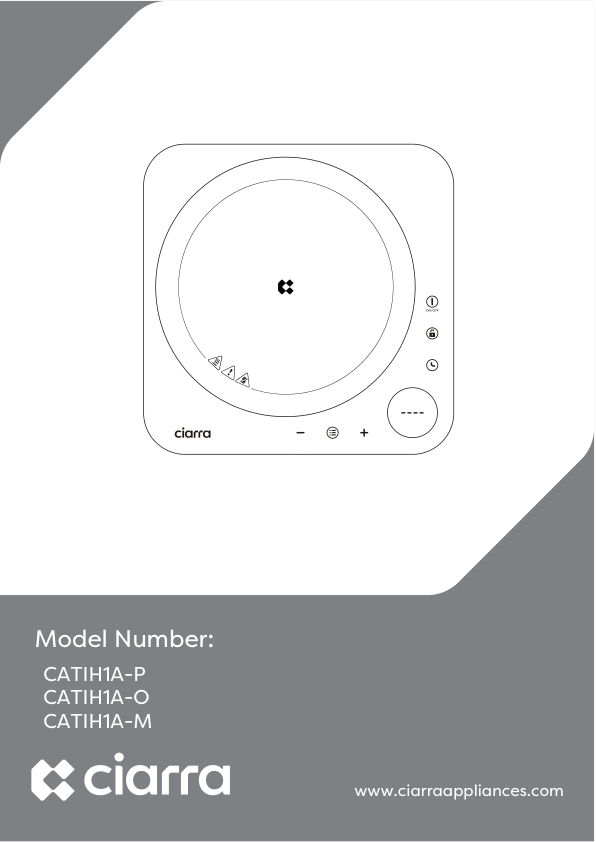
The same manual cover names CATIH1A-O, and a U.S. retailer category result identifies O as an orange, 12-inch, 1,500-watt, single-element induction cooktop. The manual supplies one one-zone control sequence for P, O and M, so the Orange finish belongs with this assessment rather than being treated as another burner design. This is a finish-family decision, not proof that every external detail is identical: no O-specific body measurements, warranty or current seller offer are established here. The image below is the manufacturer’s neutral line illustration from that shared manual. It lists all three model codes but does not depict an Orange finish. Color is an appearance choice in the available evidence; if you seek O specifically, check that the seller’s model field says CATIH1A-O.
What the shared manual says the P can do
The booklet describes one induction cooking zone and two discrete control modes. Power mode has eight labeled steps: 200, 400, 600, 800, 1,000, 1,200, 1,400 and 1,500 watts. Temperature mode also has eight choices: 140, 210, 260, 300, 350, 390, 430 and 460°F. These are spaced settings, not a continuously adjustable thermostat; the gap from 140 to 210°F is especially large. The manual does not describe a probe or say that Temperature mode senses food temperature. If a recipe depends on an internal doneness target, use a separate food thermometer rather than treating a cooktop setpoint as a reading from the food.
A one-minute-to-four-hour countdown can end the cooking session: when time expires, the unit beeps and switches off. That can help with a simmer or a planned stopping time, but it does not make unattended cooking safe—the manual warns against leaving the appliance unattended. A three-second child-lock press blocks ordinary control changes. If a pan is removed, the cooker beeps for up to 60 seconds, shows E0 and shuts off. After pressing off, its fan continues while the display shows H until the cooktop falls below 120°F, so wait for cooling before wiping or storing it.
Pan fit and setup are part of the decision
The shared instructions call for compatible magnetic cookware with a bottom between 4 and 10 inches. They name cast iron, enamel and stainless steel as suitable types and list aluminum, ceramic, copper, glass and Pyrex among cookware that will not operate properly. A magnet test on the flat pan base is a practical first check, but follow the cookware maker’s own induction guidance too. The pan’s rim is not the relevant measurement: measure the flat magnetic base. This is a one-pan appliance, so it cannot satisfy a plan that needs two pots heating at once.
The manual says to plug the cooktop into a 120-volt outlet and place it on a dry surface. It calls for at least four inches of clear space around the product so the bottom fan can draw and exhaust air. Do not put it under curtains, heat an empty or sealed vessel, immerse it, or clean it with abrasive products. It is described as a household appliance, not commercial equipment, and the booklet warns against use outdoors in rain. The exact P listing does not establish a NEMA plug subtype, circuit amperage, cord length, exact footprint or suitability for a vehicle, generator or outdoor kitchen; do not infer those from the 1,500-watt ceiling alone.
Who should consider this exact code?
The model suits someone who wants one countertop induction zone, can use a 120-volt outlet, owns a flat magnetic pan in the manual’s 4-to-10-inch base range, and values a long countdown more than fine temperature increments. Its 200-watt first Power step is a constraint, not an advantage for every cook: a requirement for a 150-watt-or-lower setting rules it out. The stepped Temperature choices may be convenient for a cook who wants labeled settings, but the 70°F jump at the bottom is too coarse for a need that calls for small setpoint adjustments.
The available retailer index labels CATIH1A-P as Cherry, while the manufacturer’s current Donut product record separately identifies the Midnight Dream CATIH1A-M. The shared manual supports the family’s operating instructions; it does not connect a specific P finish photograph to the P SKU or confirm the P package’s dimensions, warranty or present availability. Treat the Cherry name as a finish identifier, not evidence of different heating performance. If the color or package condition matters, check the seller’s current offer and model marking before purchase. If you need two simultaneous zones, a lower Power step, a documented plug subtype or a listed cord length, choose a cooktop whose own model-specific evidence answers that requirement.
Sources: Ciarra’s manual index and its CATIH1A-P/O/M instruction manual; the retailer’s CATIH1A-P listing and CATIH1A-O Orange category result; and the separate CATIH1A-M Donut product page.
Key details at a glance
| Simultaneous cooking zones | 1 |
|---|---|
| Built-in installation documented | No |
| Documented placement options | countertop |
| Selectable power modes | 200 / 400 / 600 / 800 / 1000 / 1200 / 1400 / 1500 W |
| Lowest selectable power mode | 200 W |
| Maximum listed power | 1500 W |
| Listed voltage | 120 V |
| Minimum cookware base | 4 in |
| Temperature Mode minimum | 140 °F |
| Temperature Mode maximum | 460 °F |
| Temperature settings | 8 |
| Countdown timer maximum | 240 min |
| Listed supply voltage | 120 V |
| Cooktop finish | Cherry |
| Shared output between zones | No |
| Maximum combined power across active zones | 1500 W |
| Left zone maximum when used alone | 1500 W |
| Independent maximum wattage on both zones | No |
| Zone heating technologies | induction |
| Selected package | Cherry |
| Selected offer SKU | CATIH1A-P |
Use the exact model’s instructions for operating limits, supplied equipment and version differences.
Paper, software and setup details
Cookware fit and manual discrepancy
Shared P/O/M manual specifies a flat magnetic cookware bottom from 4 to 10 inches. The exact P listing does not provide a separate pan range.
Electrical and placement note
Shared manual directs use of a 120-volt outlet. It does not establish a frequency, circuit-amperage rating, or NEMA subtype; none is inferred.
Manual-version differences
The official manual cover lists CATIH1A-P, CATIH1A-O and CATIH1A-M. The retailer index identifies P as Cherry; it does not establish current stock, warranty, dimensions or a P-specific image.
Body dimension order
No P-specific body dimensions were established; do not transfer dimensions from CATIH1A-M.
Sources for this assessment
Choose for the cooking setup you will use.
Compare exact model controls, zone count, pan fit and operating limits—not only headline wattage.