
Your needs, this model
Does it fit your priorities?
Does the BIC 132 document two induction zones that can operate together?
Yes. Its exact manual describes front and rear induction burners. They share output: when both operate, neither can go above level 7 and their combined ceiling is level 10, so two zones do not mean two simultaneous 1,800 W peaks. The model remains outside buying recommendations until its electrical rating is clarified.
Explore this need in the finder →Does the BIC 132 manual document a 100 W mode?
Yes. The model-specific power table begins at 100 W for either zone. The 120/110 V and circuit conflict remains unresolved, so a low-watt setting does not establish outlet compatibility.
Explore this need in the finder →Can each BIC 132 zone be set for as long as 99 minutes?
Yes. The exact manual lists 1 to 99 minutes for each selected element, while also describing a separate two-hour continuous-use shutoff. This does not resolve its electrical conflict or make the model a buying recommendation.
Explore this need in the finder →Equator BIC 132: a vertical two-zone reference with an unresolved electrical rating
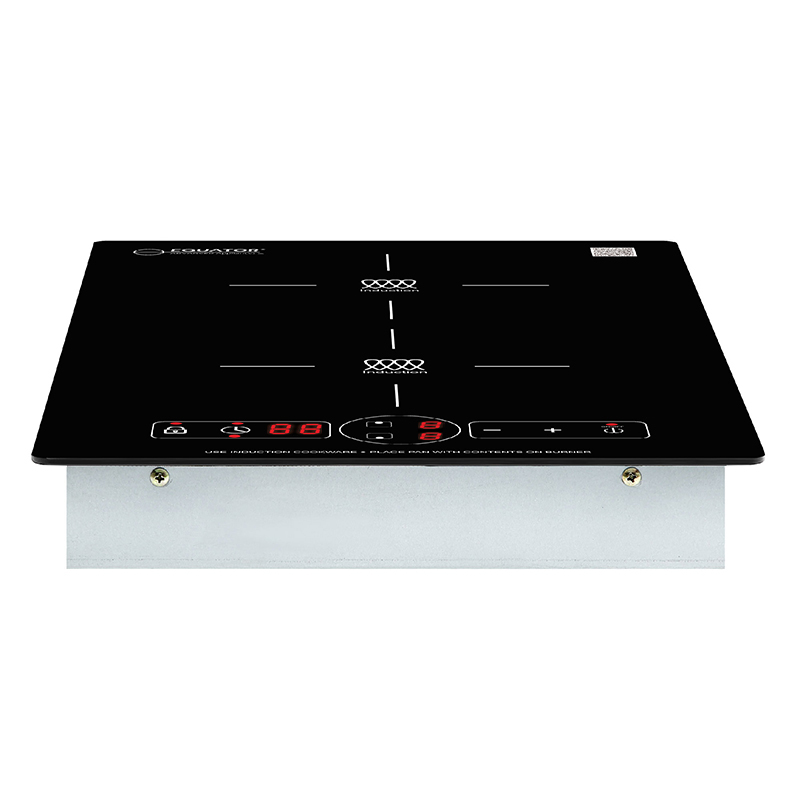
The BIC 132 is a black glass, two-zone induction cooktop laid out front-to-back rather than left-to-right. Equator calls it a built-in/freestanding model, and the exact owner manual shows four screw-on feet for using it directly on a countertop. That makes the layout relevant to someone comparing countertop cooking surfaces, but it does not make the BIC 132 a safe buying recommendation: the exact product page and model-specific manual conflict over the electrical rating and required circuit. Keep this review for model identification and installation planning only until Equator confirms the rating label and the connection method for the exact unit. This is source-based research, not an ownership or performance test.
Read the footprint as a vertical layout
The manual depicts two induction zones one above the other, with the controls at the near end. Its body drawing is about 13⅜ inches wide by 20½ inches deep and 2⅛ inches high; the product page rounds that to 13.4 by 20.5 by 2.1 inches and lists 13 pounds net. The “13-inch” description is therefore not a promise of a shallow 13-inch-deep surface. Measure the full front-to-back area and leave working room for a pan handle before treating it as a fit for a narrow counter.
The separate zone buttons and front control strip are useful when the cooking vessels sit in a line. But this arrangement uses more depth than a side-by-side double burner. If your counter is deep but narrow, the BIC 132’s shape may make more sense than the horizontal Equator BIC 202; if pans must sit shoulder-to-shoulder, the 20-inch BIC 202 or the newer BIC 202 CC ED uses a different arrangement and must be judged from its own model documents.
Its manual gives real power levels—and a shared ceiling
The model-specific BIC 132 control pages list nine wattage levels per zone: 100, 300, 500, 700, 900, 1,100, 1,300, 1,600 and 1,800 watts. Those steps are more informative than an unexplained row of numbered levels. The exact page also lists 1,800 watts total and 1,800 watts for each front and rear burner, but the manual explains that the two cannot both operate at that peak together. When both are running, neither can rise above level 7 and the pair has a combined ceiling of level 10; raising one side can cause automatic reduction of the other. A shopper should not interpret “two 1,800-watt zones” as 3,600 watts available at once.
The manual describes a 1-to-99-minute timer for each active zone. At zero, it beeps and turns off the selected element. A separate troubleshooting page says continuous use of any zone for two hours can trigger an automatic shutoff, so the timer maximum is not permission to leave cooking unattended. The glass can remain hot after power-off; the manual describes an “H” residual-heat display until the surface cools. No separate Fahrenheit temperature mode or food-probe setup is documented for the BIC 132, so its wattage levels should not be treated as pan-temperature settings.
Countertop feet do not settle the installation question
For freestanding use, the manual says to screw the four supplied feet into the underside and place the unit on the counter. For a cutout installation, it instead calls for a qualified technician and describes ventilation, heat-resistant surrounding material and installation clearances. Those are distinct setups; a countertop plan should not inherit built-in wiring instructions, and a built-in plan should not be improvised from the freestanding feet. The BIC 132 is about 13 pounds and the reviewed evidence does not show a carry handle, so it is better understood as a heavy countertop surface than as a travel burner.
Cookware must be induction-compatible. The product description explains the magnetic-vessel requirement, but the evidence reviewed for this exact model does not establish a minimum magnetic base diameter or a conservative maximum pan diameter. Do not transfer a size threshold from the similarly named BIC 202, BIC 122 CC ED or BIC 202 CC ED. Check the instructions supplied with the exact unit and the pan maker’s induction guidance.
The electrical conflict is a stop sign, not a puzzle to solve by arithmetic
The BIC 132 page is titled as a 110-volt model, while its specifications table says 120 volts, 60 hertz, 31 amps and 1,800 watts. The combined BIC 132/BIC 202 manual’s installation drawing labels the BIC 132 120 V / 60 Hz / 1,800 W. Yet the manual’s later model table lists both BICs at 110 V / 60 Hz / 1,800 W with a 20-amp minimum breaker, and its built-in wiring section separately calls for a grounded 120-volt supply. These statements do not establish the correct countertop plug, circuit or rating for an individual BIC 132. I leave voltage, current and plug type unknown rather than picking the most plausible-looking line.
If you already have a unit, use the rating label on the appliance and ask Equator for the current instructions matching its serial number before connecting or installing it. For a new portable-cooktop shortlist, choose a model whose exact documentation clearly identifies its household supply and countertop use. The regular Equator PIC 200 N has its own reviewed manual and is a more directly portable comparison; do not substitute BIC 202 CC ED documents just because the older BIC 202 name is similar. Until the BIC 132’s electrical bridge is corrected, its defining strengths—vertical two-pan arrangement and detailed power sharing—are not enough to clear the essential compatibility question.
Sources: Equator BIC 132 exact U.S. product page; combined BIC 132/BIC 202 owner manual linked by Equator.
Key details at a glance
| Simultaneous cooking zones | 2 |
|---|---|
| Built-in installation documented | Yes |
| Documented placement options | countertop / built_in |
| Selectable power modes | 100 / 300 / 500 / 700 / 900 / 1100 / 1300 / 1600 / 1800 W |
| Lowest selectable power mode | 100 W |
| Maximum listed power | 1800 W |
| Body depth | 20.5 in |
| Body width | 13.4 in |
| Body height | 2.1 in |
| Listed unit weight | 13 lb |
| Listed manufacturer's warranty term | 1 year |
| Countdown timer maximum | 99 min |
| Listed unit weight | 13 lb |
| Cooktop finish | Black |
| Shared output between zones | Yes |
| Maximum combined power across active zones | 1800 W |
| Left zone maximum when used alone | 1800 W |
| Right zone maximum when used alone | 1800 W |
| Independent maximum wattage on both zones | No |
| Zone heating technologies | induction / induction |
Use the exact model’s instructions for operating limits, supplied equipment and version differences.
Paper, software and setup details
Cookware fit and manual discrepancy
The manual and product page require induction-compatible magnetic cookware. A BIC 132-specific minimum magnetic base and conservative maximum pan diameter are not established in the inspected exact documentation; do not borrow the BIC 202 manual range.
Electrical and placement note
Exact product page title says 110V; its table says 120 V / 60 Hz / 31 A / 1,800 W. Manual printed pp.5 and 6 list 120 V / 60 Hz / 1,800 W; later printed p.10 table says 110 V / 60 Hz / 1,800 W and a 20 A minimum breaker. Built-in wiring text separately says grounded 120 V / 60 Hz. Which applies to freestanding use, and the plug/circuit, remain unknown.
Placement and permitted-use guidance
The exact combined manual shows four supplied feet screwed into the bottom for direct countertop placement. Built-in placement instead requires a qualified technician and its own cutout, ventilation, clearances and wiring; the electrical instructions conflict.
Sources for this assessment

Choose for the cooking setup you will use.
Compare exact model controls, zone count, pan fit and operating limits—not only headline wattage.