
Your needs, this model
Does it fit your priorities?
Does the BIC 202 manual document a separate 120–460°F cooktop Temperature mode?
Yes. The model-specific manual describes Power and Temperature settings and gives a 120–460°F range. It does not document a wired food probe or a Fahrenheit adjustment step in the sections reviewed. The separate mode does not resolve the electrical-rating conflict.
Explore this need in the finder →Can the BIC 202 heat two pans at once?
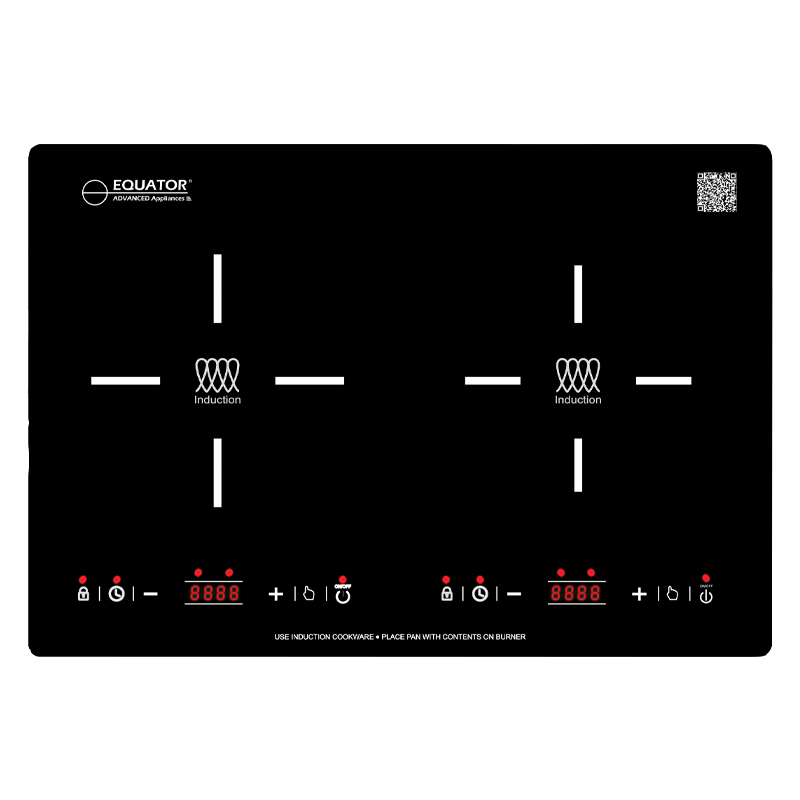
Yes. Its exact manual depicts two induction zones with separate controls. They share output and have an 1,800 W combined ceiling; this is not independent full-power output on both zones. The unresolved supply rating keeps it outside buying recommendations.
Explore this need in the finder →Can its timer cover a 2-hour-59-minute cooking window?
Yes. The BIC 202 manual lists a 1-minute-to-2-hour-59-minute timer and says the selected element turns off when that timer ends. The same manual describes an automatic two-hour continuous-operation shutoff, so the timer range is not a continuous-run promise.
Explore this need in the finder →Equator BIC 202: a horizontal double burner whose voltage remains unclear
The older Equator BIC 202 is a two-zone black glass induction surface arranged side by side. Its exact product page calls the model built-in/freestanding, and the combined BIC 132/BIC 202 owner manual provides four screw-on feet for countertop placement. That makes it an interesting identification case for a household comparing a horizontal double burner, but not a positive purchase pick yet. The product page and exact manual disagree about voltage and circuit requirements; a countertop label does not remove that conflict. This assessment keeps the electrical unknown visible and is not based on ownership or laboratory testing.
Horizontal zones and the output difference
The product page lists a 20.5-inch width, 14.1-inch depth and 2.1-inch height, with a net weight of 13.5 pounds. That is a broad, shallow arrangement compared with the front-to-back BIC 132, which occupies more counter depth and less width. The BIC 202 layout gives two pan positions side by side, each with its own controls, but the two-zone label does not mean both can run at their individual maximum simultaneously.
Equator’s exact page lists 1,800 watts for the left burner and 1,300 for the right, but still 1,800 watts total. Its model-specific manual explains automatic power sharing and says the pair cannot exceed a combined 1,800-watt limit. It also gives separate power tables: the left side has 300-to-1,800-watt steps while the right side has 300-to-1,300-watt steps. The page calls the cooktop a nine-power-level model, while the manual’s table enumerates eight wattage levels. The useful distinction is the left/right ceiling and shared total, not an assumption that every display number maps to identical wattage on both sides.
A real temperature mode, but not a food probe
Unlike the BIC 132’s manual, the BIC 202 manual includes both Power and Temperature modes. It gives a temperature range of 120°F to 460°F, but does not publish a step interval in the material reviewed. This is a cooktop setting, not evidence of a wired probe or a food-internal temperature reading. If an exact fine step or probe function matters, neither should be inferred from the word “temperature.” The manual’s dual-zone power sharing still applies when using the two positions together.
The BIC 202 manual lists a 1-minute-to-2-hour-59-minute timer and says the selected heating element switches off when its countdown ends. It also includes a control lock and a residual-hot-surface indicator. The same booklet describes automatic shutoff after two hours of uninterrupted operation. These are useful limits to understand for a routine involving unattended simmering: timer length and continuous-run protection are different safeguards, and neither changes the manual’s hot-glass warning.
Cookware and placement details
The exact manual calls for flat-bottom, induction-compatible cookware with an overall diameter of 4.7 to 10.83 inches. It says a pan under 4.7 inches will not work, and advises centering the vessel over the selected heating zone. That number is a cookware diameter in the manual, not a separately measured magnetic-base threshold. Use it as an overall-pan guide, not as a guarantee about a particular small or irregularly based vessel. Do not apply this range to the BIC 132 unless its own current instructions confirm it.
The four feet permit direct countertop placement when installed as shown. The alternative built-in method has a cutout drawing and instructions for a qualified technician, including ventilation and surrounding-surface requirements. A surface intended to fit a cabinet opening is not automatically a plug-in or travel appliance. The BIC 202 has no carry handle shown in the reviewed evidence, and its 13.5-pound net weight makes relocation less convenient than a light single-burner cooker.
Why the electrical question blocks a buying recommendation
The current product page’s title describes a 110-volt cooktop, but its specification table says 120 V / 60 Hz / 15 A / 1,800 W. The model-specific manual’s installation drawing labels the BIC 202 at 120 V / 60 Hz / 1,800 W; its later specification table instead says 110 V / 60 Hz / 1,800 W and a 20-amp minimum circuit breaker. The manual’s built-in wiring paragraph again specifies a grounded 120-volt supply. Those are not interchangeable connection instructions. I therefore leave voltage, plug type and circuit current unconfirmed; the page’s 1,800-watt total does not authorize guessing a compatible household outlet.
If you own a BIC 202, confirm its rating label and obtain Equator’s corrected model-specific connection instructions before using the unit. If shopping, compare it with the newer BIC 202 CC ED only as a separate model with a separate manual—not as a silent revision of the older BIC 202. The Equator PIC 200 N is a more directly portable two-zone alternative with its own reviewed documents, although its shared-output limits also deserve checking. For a buyer who requires a verified supply, use a different exact model until this BIC 202 conflict is resolved.
Sources: Equator BIC 202 exact U.S. product page; combined BIC 132/BIC 202 owner manual linked by Equator.
Key details at a glance
| Simultaneous cooking zones | 2 |
|---|---|
| Built-in installation documented | Yes |
| Documented placement options | countertop / built_in |
| Lowest selectable power mode | 300 W |
| Maximum listed power | 1800 W |
| Body depth | 14.1 in |
| Body width | 20.5 in |
| Body height | 2.1 in |
| Listed unit weight | 13.5 lb |
| Listed manufacturer's warranty term | 1 year |
| Temperature Mode minimum | 120 °F |
| Temperature Mode maximum | 460 °F |
| Countdown timer maximum | 179 min |
| Listed unit weight | 13.5 lb |
| Cooktop finish | Black |
| Shared output between zones | Yes |
| Maximum combined power across active zones | 1800 W |
| Left zone maximum when used alone | 1800 W |
| Right zone maximum when used alone | 1300 W |
| Right-zone power table when used alone | 300 / 500 / 700 / 900 / 1100 / 1300 W |
| Independent maximum wattage on both zones | No |
| Zone heating technologies | induction / induction |
Use the exact model’s instructions for operating limits, supplied equipment and version differences.
Paper, software and setup details
Cookware fit and manual discrepancy
The exact BIC 202 manual calls for flat-bottom induction cookware with an overall diameter from 4.7 to 10.83 inches. This is not a separately documented magnetic-base threshold; check the exact pan bottom and its manufacturer guidance. Do not transfer this range to the BIC 132.
Electrical and placement note
Exact product page title says 110V; its table says 120 V / 60 Hz / 15 A / 1,800 W. The manual installation drawing labels 120 V / 60 Hz / 1,800 W; its later model table instead lists 110 V / 60 Hz / 1,800 W and a 20 A minimum breaker. Built-in wiring text separately specifies grounded 120 V / 60 Hz. Correct freestanding voltage, current and plug/circuit remain unknown.
Placement and permitted-use guidance
The exact combined manual shows four supplied feet screwed into the bottom for countertop placement. Built-in placement instead requires a qualified technician and its own cutout, ventilation, clearances and wiring; the electrical instructions conflict.
Sources for this assessment

Choose for the cooking setup you will use.
Compare exact model controls, zone count, pan fit and operating limits—not only headline wattage.