
Your needs, this model
Does it fit your priorities?
Do both zones need induction, or is one ceramic zone useful?
The exact EHC 20211 manual and spec sheet identify one induction burner and one ceramic burner. It cannot meet an all-zones-induction essential need.
Explore this need in the finder →Is an installed built-in opening acceptable?
The exact manual says built-in household use only and gives cutout instructions, while the current product page also claims freestanding use. This unresolved mode conflict keeps the model in identification-only reference status.
Explore this need in the finder →Can this exact model serve as a portable freestanding cooktop?
Do not infer that from the product page alone: the exact manual says built-in household use only. Ask Equator for the current instructions for the exact revision before considering non-installed use.
Explore this need in the finder →Equator EHC 20211: a model reference, not a portable-cooktop recommendation
The EHC 20211 is Equator’s 20-inch hybrid glass cooktop: one induction zone beside one radiant ceramic zone. It is easy to mistake for a portable induction double burner because the current U.S. product page calls it both “built-in” and “freestanding.” The exact owner manual, however, says the appliance is designed for built-in household use only and gives instructions for a counter cutout. Until Equator reconciles that difference for this exact model revision, this page is useful for identifying an existing EHC 20211 or checking a listing—not a positive pick for someone who needs a true countertop appliance. I have not tested or owned it; this is a source-based assessment.
Two zones, two cookware rules
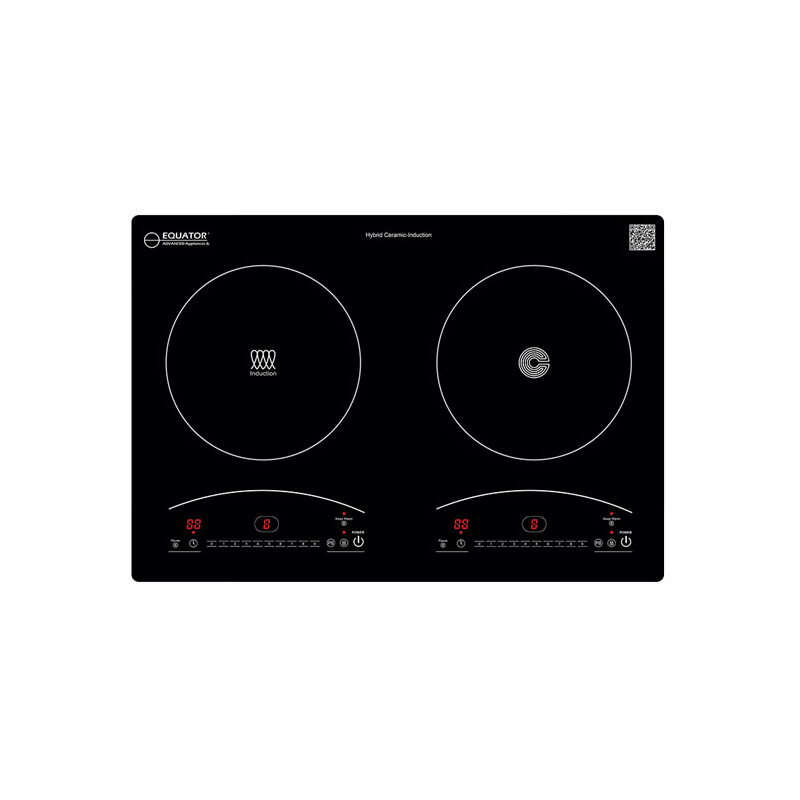
The left zone is induction and the right is radiant ceramic. That mix is the product’s defining distinction: the manual says to use induction-compatible cookware on the induction side and says the ceramic burner can use cookware for electric cooking. A shopper who needs all zones to recognize magnetic cookware should not count this as an all-induction cooktop. Someone comparing it because they own both magnetic and non-magnetic pans should understand that they are not interchangeable across the two rings. The maker’s exact image and manual diagram depict separate induction and ceramic circles, matching the written one-plus-one configuration.
There is a small but material identity wrinkle on the product page. Its heading says “1 Induction and 1 Ceramic,” while the image alt text says “2 Induction and 2 Ceramic.” The matching EHC 20211 manual cover, manual feature diagram and spec sheet all identify one induction and one ceramic burner. I use the exact suffix EHC 20211, not the related EHC 23422 or larger 30- and 36-inch EHC models. The latter are separate built-in multi-zone designs, not larger versions of a portable burner.
Installation is the deciding limitation
Equator’s page advertises a built-in or freestanding format. Its EHC 20211 manual’s “Intended Use” section says built-in household use only, and its installation section tells the installer to check the cutout and surrounding heat-resistant surfaces. The manual diagram lists a 19.7-by-13-inch cutout for a body measuring 20.5 by 14.1 by 2.2 inches; it also sets small clearances around that opening and calls for space above and around the appliance so intake and exhaust air are not blocked. These are installation details, not a travel or countertop-clearance plan. The manual says not to use it outdoors or to heat a room. Its page and manual should not be blended into an assumed portable setup just because one page calls it freestanding.
Power sharing and controls
The page and exact manual describe nine power levels, separate timers for the two zones, Keep Warm, Pause, a child lock, residual-heat indication and automatic shutoff. The listed total is 1,750 watts, with automatic power sharing; simultaneous use therefore does not mean both surfaces can deliver their individual maximum at once. The manual table gives the induction side as 1,200 watts with a 1,400-watt Boost and the ceramic side as 1,000 watts. The product-page description elsewhere says the induction Boost reaches 1,600 watts, so I would not use the conflicting individual peak as a requirement. Neither nine power levels nor Boost is the same as a documented Fahrenheit pan-temperature mode, and the reviewed material does not identify a food probe.
A 99-minute countdown is listed for each zone. The controls include useful everyday functions, but the source material does not make this a precision temperature controller. If choosing a cooktop because it must hold a specific pan temperature, require a probe, or provide a known low-watt setting, treat any undocumented detail as unknown rather than assuming the control labels imply it.
Electrical details also need confirmation
The exact page’s feature text says 110 V / 60 Hz, its specification table says 120 V / 60 Hz / 15 A, the linked spec sheet says 110 V / 60 Hz / 15 A, and the exact manual table says 120 V / 60 Hz / 15 A. Frequency and a 15-amp listing recur, but the voltage presentation does not. I leave the voltage unconfirmed rather than choosing a likely-looking number or combining sources into a broader range. This discrepancy, together with the freestanding-versus-built-in conflict, is why an essential electrical or portable-use need should not be marked as a fit on this record. The page also showed a “Notify Me” control when checked; that is not a promise of current stock or a reason to substitute a seller listing for the exact instructions.
How to use this comparison
If you need a portable induction cooker that can sit on a counter as an everyday appliance, compare models whose exact manual documents that placement and a compatible electrical setup; Equator’s PIC 100 and PIC 200 N are separate product families with their own guides. If you want a built-in surface with one induction and one ceramic position, the EHC 20211 may be worth identifying, but first ask Equator for the current manual and rating information for the exact unit and revision. If all zones must be induction, if outdoor use matters, or if you need a verified plug-in tabletop plan, this EHC reference should stay out of that shortlist.
In short, the model’s useful difference is hybrid cookware flexibility within a compact built-in glass panel. Its important limits are that the exact manual restricts intended use to built-in household installation, the product page contradicts that on freestanding use, and the published voltage and one Boost figure disagree. This assessment keeps those uncertainties visible rather than turning a hybrid built-in cooktop into a portable induction recommendation.
Sources: Equator’s exact EHC 20211 U.S. page; EHC 20211 owner manual linked from that page; EHC 20211 spec sheet.
Key details at a glance
| Simultaneous cooking zones | 2 |
|---|---|
| Built-in installation documented | Yes |
| Documented placement options | built_in |
| Body depth | 14.1 in |
| Body width | 20.5 in |
| Body height | 2.2 in |
| Listed manufacturer's warranty term | 1 year |
| Dedicated Keep Warm shortcut | Yes |
| Countdown timer maximum | 99 min |
| Cooktop finish | Black |
| Shared output between zones | Yes |
| Maximum combined power across active zones | 1750 W |
| Right zone maximum when used alone | 1000 W |
| Independent maximum wattage on both zones | No |
| Zone heating technologies | induction / ceramic |
Use the exact model’s instructions for operating limits, supplied equipment and version differences.
Paper, software and setup details
Cookware fit and manual discrepancy
Exact manual says any cookware can be used on the ceramic burner; induction-compatible cookware is needed for the induction burner. This is not all-zone induction.
Electrical and placement note
Voltage is unknown: page narrative and linked specification say 110V/60Hz/15A; same page table and exact manual say 120V/60Hz/15A. The page narrative also says 1600W induction Boost while its table and manual say 1400W. Unknown values do not meet essential requirements.
Placement and permitted-use guidance
Exact manual says built-in household use only and gives a cutout; the exact product page also claims freestanding. Do not use as a portable tabletop plan without current manufacturer clarification.
Sources for this assessment

Choose for the cooking setup you will use.
Compare exact model controls, zone count, pan fit and operating limits—not only headline wattage.