
Your needs, this model
Does it fit your priorities?
Is the #6200 a separate induction-zone design from the #6000?
No. Both exact manuals describe one induction zone and the same listed 1,800 W ceiling, ten power levels, ten temperature levels and 180-minute timer. The 6200's documented distinction is an upgraded stainless outer body; it is not a second burner.
Explore this need in the finder →What cookware size should I use with an existing 6200?
The manual and product sheet agree on a 13-inch recommended maximum. Their minimum differs: manual 4 inches, product sheet 4.5 inches. The shortlist uses 4.5 inches conservatively, so a need to use a 4-inch base does not qualify.
Explore this need in the finder →Will the older Deluxe run for at least three hours before its timer switches it off?
The exact manual sets the maximum at 180 minutes; it beeps and turns off at expiry. A longer timer request is not confirmed.
Explore this need in the finder →The #6200's distinction is its body, not its cooking layout
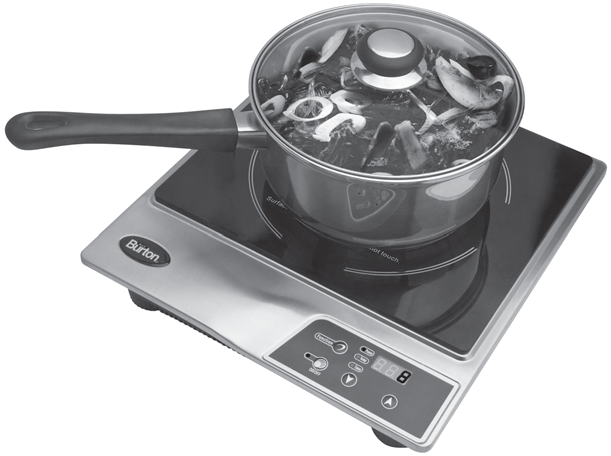
Max Burton's #6200 Deluxe is an earlier one-zone induction cooktop with a stainless outer body. The exact manual and product sheet describe a plug-in 120-volt appliance with ten selectable power levels, ten temperature settings and a 180-minute timer. The manufacturer's 2016 catalog places #6200 in its household induction cooktop group. Those documents help identify a real product, but they are old: I did not find a current exact-model sales page or stock confirmation. Treat this as an assessment for an existing unit or an exact model you are separately checking, not proof that a new one is currently available.
It is easy to overread the word Deluxe. The archived sheet calls the stainless body an upgrade, but the documented cooking arrangement remains one induction zone with a maximum of 1,800 watts. It is not a two-pan appliance, and it does not add a food probe, programmable stages or continuous temperature selection. If the #6000 and #6200 are being compared, the most concrete difference is casing and weight: the #6200 is listed at 6 pounds, 12 ounces while the #6000 is 5 pounds, 12 ounces. Both share the listed outside dimensions of 13.3 by 12.5 by 2.6 inches.
Choose between direct power and fixed temperature targets
The controls separate Power mode from Temperature mode. The manual's watt table lists ten power choices from 200 watts at level 1 through 1,800 watts at level 10, with specific intermediate levels rather than a continuously variable slider. The product data sheet summarizes the range as 500–1,800 watts, so its lower endpoint conflicts with the #6200 manual's level-1 table. If a very low setting matters for a particular recipe, verify the control and exact instructions on the unit in hand instead of silently treating those documents as identical.
Temperature mode has ten discrete settings, beginning at 100°F and reaching 450°F. The published temperatures do not advance by a regular single increment; a single maximum-step specification would therefore be misleading. This is cooktop temperature control, not a wired probe that measures the center of food. For delicate tasks, the useful question is whether fixed settings fit your routine, not whether the model has an unlisted sensor accuracy.
The countdown timer tops out at 180 minutes and turns the cooktop off when time runs out. It is a shutoff, not a license to leave a pan unattended. For longer recipes, you would need a different plan rather than assuming the timer can extend beyond its documented limit.
Use the conservative cookware threshold
The #6200 sources agree that cookware should be flat and magnetic, and the manual recommends a maximum diameter of 13 inches. They disagree on the lower end: the operating manual says a 4-inch minimum cookware bottom, while the product sheet says the base should be at least 4.5 inches across. The matching profile uses the more conservative 4.5-inch figure. That means a user who must use a 4-inch base should not be told the cooktop qualifies based only on the less cautious booklet line. The upper figure is a recommendation, not a measured outside-rim allowance.
The manual's setup advice is equally important. It calls for a dedicated 120 V/15 A outlet and at least four inches of space around airflow areas. It says to keep the unit on a dry, stable, level surface, not a metal surface, and not to heat an empty vessel. The pan-contact area can stay hot after cooking, while the fan may keep running until the appliance cools. These constraints can make a small counter less convenient than the headline 1,800-watt rating suggests.
A separate #6010 interface disk can be used for some cookware that is not induction-ready, but it is an accessory, not an assumed part of the base #6200 package. The official archive lists a #6050 set containing the #6200 and #6010. Check the exact package label if the disk is essential: a model code for the set and the base cooker are not interchangeable descriptions. Using an interface disk also adds a heated layer and the manufacturer says efficiency can vary.
When the older-model choice is sensible
The #6200 is a reasonable fit for identifying an existing unit or evaluating an exact used offer when one pan, a stainless housing, ten fixed temperature choices and the 180-minute cutoff are useful. In the finder, enabling earlier models is necessary before it can appear. A one-zone answer does not distinguish it from the #6000; a silver/stainless finish preference can, and a 4.5-inch minimum pan-base requirement keeps the conservative cookware boundary visible.
Do not choose it for simultaneous cooking, a probe requirement, a timer longer than 180 minutes or fine-grained setpoint intervals. It also should not be treated as more powerful because of the Deluxe name; the documented ceiling is the same 1,800 watts as the #6000. For a current-reference product, compare a model with a current exact listing such as the Hamilton Beach 34104, or inspect a verified Duxtop one-zone model. Those are alternatives to evaluate, not direct substitutes with identical cookware guidance.
Bottom line
The #6200 is best understood as a stainless-bodied, earlier one-pan cooktop with familiar but fixed controls. Its main practical benefit over the #6000 is the documented casing choice, not another burner or a new cooking mode. The old manual and product sheet are useful for model identification, but their cookware minimum conflicts and they do not settle current sales availability, condition or package contents. Confirm the underside model number, inspect the cord and glass, use magnetic flat cookware within the documented guidance, and keep the ventilation space clear before relying on an older unit.
Key details at a glance
| Simultaneous cooking zones | 1 |
|---|---|
| Built-in installation documented | No |
| Documented placement options | countertop |
| Selectable power modes | 200 / 500 / 800 / 1000 / 1200 / 1300 / 1400 / 1500 / 1600 / 1800 W |
| Lowest selectable power mode | 200 W |
| Maximum listed power | 1800 W |
| Body depth | 13.3 in |
| Body width | 12.5 in |
| Body height | 2.6 in |
| Listed unit weight | 6.75 lb |
| Power-cord length | 5 ft |
| Listed voltage | 120 V |
| Listed manufacturer's warranty term | 1 year |
| Minimum cookware base | 4.5 in |
| Temperature Mode minimum | 100 °F |
| Temperature Mode maximum | 450 °F |
| Temperature settings | 10 |
| Countdown timer maximum | 180 min |
| Listed supply voltage | 120 V |
| Listed unit weight | 6.75 lb |
| Cooktop finish | Silver |
| Zone heating technologies | induction |
Use the exact model’s instructions for operating limits, supplied equipment and version differences.
Paper, software and setup details
Warranty start and exclusions note
The archived 2014 sheet states a one-year performance warranty from purchase; current coverage is unknown and is not used for matching.
Sources for this assessment
Choose for the cooking setup you will use.
Compare exact model controls, zone count, pan fit and operating limits—not only headline wattage.