
Your needs, this model
Does it fit your priorities?
Is one magnetic flat-bottom pan at a time enough for your setup?
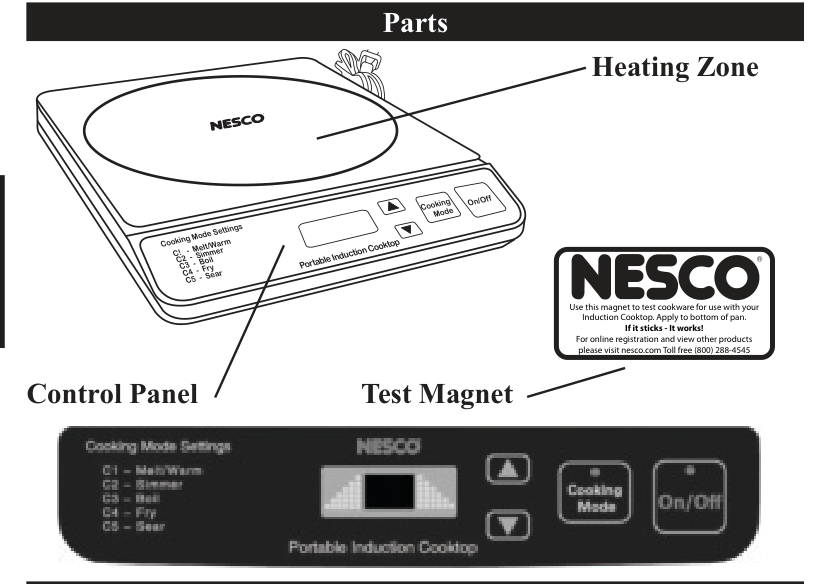
The PIC-14 manual shows one heating zone and requires a centered, induction-ready pan with a 3.15–10.00-inch base. The reference is not a current purchase result; use the finder for a verified offer.
Explore this need in the finder →Does your actual pan base fall within the manual’s stated diameter range?
The manual gives a bottom-diameter range of 3.15–10.00 inches, names cast iron, carbon steel and magnetic stainless steel as examples, and recommends the supplied magnet test. This is a fit check for an exact owner unit, not a cookware-bundle claim.
Explore this need in the finder →Is a timer, food probe or numeric pan-temperature mode essential?
The manual documents five named C modes but does not establish a timer, probe or numeric pan-temperature scale. Unknown capabilities do not meet a hard requirement; compare a model whose exact manual confirms the feature.
Explore this need in the finder →NESCO PIC-14: a manual-based owner reference
The PIC-14 is a one-zone household induction cooktop identified by NESCO’s official manual and owner-manual index. I found an exact model manual, but not a verified exact-model sales offer or current stock record. This is therefore an owner-focused reference, not a recommendation to buy a used unit or evidence that one is for sale. The manual does not establish the condition, age, present warranty coverage, or completeness of any particular surviving appliance.
Five named cooking modes, not a measured temperature scale
NESCO lists five C-mode choices: Melt/Warm, Simmer, Boil, Fry, and Sear. C1 is the low-heat end and C5 the high-heat end; when the unit is switched on, the manual says C3 appears. Those are useful labels for choosing a broad routine, but the manual gives no wattage table for the modes and no numeric pan-temperature range. If a recipe depends on a particular measured setting, treat that capability as unconfirmed rather than translating “Sear” or “Simmer” into a temperature. The manual also does not establish a timer or food probe, so neither should be assumed for a task where it is essential.
All five choices operate on the same marked cooking zone. The mode key and arrow buttons let you adjust the choice while cooking, but NESCO warns that the result varies with the cookware and that users may need to learn how each mode behaves with their own pan. That is a practical limitation for someone expecting preset labels to guarantee a result across different vessels. It is a simpler owner reference for a cook who is comfortable watching the pan and adjusting as needed.
Check the actual pan base and electrical connection
The PIC-14 manual calls for a flat, induction-compatible cookware base from 3.15 to 10 inches in diameter. That measurement is the bottom of the pan, not its rim. Cast iron, carbon steel, and magnetic stainless steel are named examples; glass, solid copper, and aluminum are not suitable. The instructions say to center the pan over the heating zone and include a magnet test: if the magnet sticks to the base, the pan is magnetic enough to test for induction use. The manual’s parts illustration shows the cooktop and test magnet, not a supplied pan; no cookware bundle is established here.
The rating page specifies 1,500 watts, 120 volts, and 60 Hz. The instructions describe a polarized two-blade plug, with one blade wider, but do not give an exact NEMA designation or circuit amperage. Do not substitute a plug type, branch-circuit requirement, cord length, or body dimension from another NESCO product. The manual describes household use only and says not to use the appliance outdoors. It calls for a flat, sturdy surface and unobstructed air vents, and cautions against operating on a metal table or countertop.
Allow for a hot surface and the cooling fan
Induction heats the compatible vessel, but the cooktop’s marked heating zone can remain hot after cooking. The manual cautions against empty or unattended pans and directs the user to keep the pan centered. It documents error codes for absent or unsuitable cookware, internal overheating, and an overheated heating zone; it does not provide a laboratory performance claim or a promise that every pan will recover identically from an error. After switching off, the cooling fan continues for about one minute. NESCO says to leave the plug in until the fan stops. For cleaning, unplug and let the appliance cool, then use a soft damp cloth; avoid immersing it or using abrasive pads on the ceramic surface.
Who should look at another model?
The PIC-14 is most useful to someone who already owns the exact unit, has a centered magnetic pan within the documented base-size range, and wants the manual’s five broad cooking choices. Its unknown timer, probe, dimensions, and exact plug type matter if any is a non-negotiable requirement. NESCO’s archived manual states a one-year limited warranty tied to the original purchase, but that old wording does not confirm coverage now.
For a new purchase, use the finder to compare models with a verified sales route rather than treating this support/manual record as available stock. If a separate pan-temperature mode is important, the Duxtop 9600LS assessment documents one with selectable 100–460°F settings; its sensor estimates cookware temperature and is not a food probe. If two pans must heat at once, choose a confirmed dual-zone configuration instead. Read the NESCO owner-manual index and PIC-14 manual for exact operating and safety instructions, and check the label and supplied manual on the specific unit before using it.
Key details at a glance
Use the exact model’s instructions for operating limits, supplied equipment and version differences.
Sources for this assessment
Choose for the cooking setup you will use.
Compare exact model controls, zone count, pan fit and operating limits—not only headline wattage.