
On this page
Your needs, this model
Does it fit your priorities?
Will your exact unit's guide and nameplate both identify PIC-14SK?
The PIC-14SK code appears in a guide credited to The Metal Ware Corporation and in an exact-name U.S. seller listing. NESCO's current owner-manual index lists PIC-14 separately; verify the actual appliance label and supplied guide rather than substituting PIC-14 details.
Explore this need in the finder →Is a particular minimum pan-base diameter essential?
Not verified: the guide says 3.15 inches in the operating steps but describes an E1 error below 4.75 inches. The minimum is unknown, so it cannot satisfy an essential pan-fit requirement.
Explore this need in the finder →Do you require a numeric pan-temperature mode, timer or food probe?
The guide names five C modes but does not document a numeric temperature scale, timer or food probe. Treat each as unknown, not as either a confirmed feature or a confirmed absence.
Explore this need in the finder →Open Country PIC-14SK: an owner reference, not a fresh-buy pick
The PIC-14SK is a single-zone household induction cooktop identified by a care/use guide that names the Open Country product and credits The Metal Ware Corporation. A U.S. seller page also uses the exact PIC-14SK name and shows an Open Country-branded unit. That establishes a useful model-code reference, but not the condition or current availability of any particular appliance. I have not established a current manufacturer sales route or a dependable stock state, so this page should not be read as a recommendation to buy one.
Keep the code distinct from the NESCO PIC-14. NESCO’s current owner-manual index lists PIC-14, while the separate care/use guide discussed here says PIC-14SK. The relationship between those codes and their physical revisions is not established. If you are checking an existing unit, read its underside label and compare it with the guide supplied with that unit; do not use the PIC-14 manual to fill in PIC-14SK gaps.
Five broad mode labels, without a numeric control chart
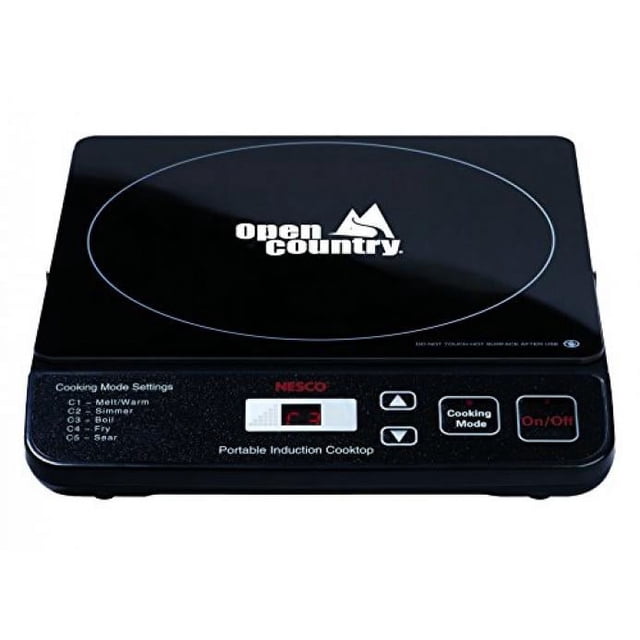
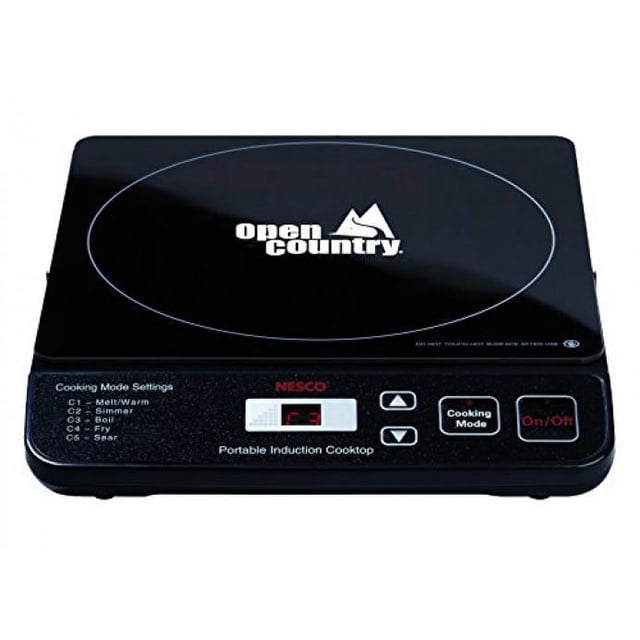
The PIC-14SK guide describes one marked cooking zone and five C modes: C1 Melt/Warm, C2 Simmer, C3 Boil, C4 Fry and C5 Sear. C1 is characterized as the low-heat end and C5 as the high-heat end; C3 is displayed when cooking mode is activated. The arrow controls let the user change the selected mode. These names can help an owner choose a broad starting point, but the guide does not give wattage for each mode or a numeric pan-temperature schedule. Do not interpret “Sear” as a guaranteed temperature or a measured performance result.
That distinction matters if your usual cooking relies on repeatable pan temperatures, a countdown timer or a food probe. The guide does not document any of those functions. That leaves their status unknown, not proven absent; still, unknown is not enough when one of them is non-negotiable. For a documented separate pan-temperature mode, compare the existing Duxtop 9600LS reference. If you need the exact timer length, check that model’s product facts and manual before choosing it.
Measure the pan base—and note the manual conflict
The guide asks for a flat, induction-compatible pan centered on the heating zone. Its operating instructions state a base-diameter range of 3.15 to 10 inches, but the E1 error-code description says a pan below 4.75 inches is too small. Those two minimums disagree in the same guide. The maximum is consistently stated as 10 inches; the minimum cannot be treated as settled. If your small skillet is near either threshold, do not assume it will be detected simply because a magnet sticks. Check the exact unit and use another cooktop with a clearly documented minimum if the answer must be known before use.
The guide names cast iron, carbon steel and magnetic stainless steel as suitable examples, and says glass, solid copper and aluminum are not suitable. It includes a magnet check for cookware, but does not identify a cookware set as part of the PIC-14SK package. Those instructions support a practical pan check, not a promise that every magnetic-bottom vessel will perform the same way.
Electrical fit and where it can be used
The rating printed in the guide is 1,500 watts, 120 volts and 60 Hz. The plug is described as polarized, with one blade wider than the other; an exact NEMA designation, current draw and circuit requirement are not given. If a particular outlet, extension arrangement or circuit limit is essential, the available documentation does not settle it. The guide calls the appliance for household use and says not to use it outdoors, even though portable-cooktop listings sometimes use broad travel-oriented language. It also says to keep the cooling vents clear and avoid operating on a metal table or countertop.
When cooking, avoid an empty or unattended pan and keep it centered. After switching the unit off, the internal fan runs for about a minute; the guide says to leave the plug connected until the fan stops. For care, unplug after cooldown and wipe with a soft damp cloth rather than immersing the appliance or using abrasive pads.
Questionnaire tradeoffs and alternatives
The PIC-14SK fits an existing-unit question when you want one indoor induction zone, a 120 V supply and broad Melt/Warm through Sear choices. It is a poor answer to a strict minimum-pan-size request because the manual conflicts with itself, and it cannot meet an essential timer, temperature-mode or probe requirement on the available evidence. A need for two pans at once calls for a separately verified dual-zone model. A need for higher rated power should be compared by documented wattage rather than by guessing cooking speed from a label. The guide’s one-year warranty wording dates from 2014 and does not establish coverage for a used unit now.
The visible one-zone surface and C1–C5 controls help identify the format, but they do not resolve the manual’s pan-size conflict or establish timer, probe or electrical fit. For safety and exact controls, consult the PIC-14SK care/use guide, and verify the code printed on the particular appliance. This is an identification aid for an exact model owner, not a substitute for its own label, manual or service instructions.
Key details at a glance
Use the exact model’s instructions for operating limits, supplied equipment and version differences.
Sources for this assessment
- Open Country Portable Induction Cooktop PIC-14SK Care/Use Guide, credited to The Metal Ware Corporation; browser-rendered copy
- Walmart Business listing titled Open Country PIC-14SK Portable Induction Cooktop
- Image served on exact-name Walmart Business PIC-14SK listing
- NESCO Owner's Manual Download index
Choose for the cooking setup you will use.
Compare exact model controls, zone count, pan fit and operating limits—not only headline wattage.