
On this page
Your needs, this model
Does it fit your priorities?
Do you need two pans heating at once, and do you understand that the BG62 manual limits their combined draw to 1,800 W?
The manual identifies a double-burner cooktop. It documents power sharing at a combined 1,800 W; if your routine requires two separate peak outputs, this configuration does not meet that need. The record remains reference-only.
Explore this need in the finder →Must each zone deliver its separate maximum wattage simultaneously?
No. Ovente’s examples say a requested 1,800 W on one side leaves zero for the other, and 1,300 W on one leaves 500 W for the other. The exact manual says power is adjusted when the combined settings exceed 1,800 W.
Explore this need in the finder →Is a precise smallest pan-base diameter essential?
The manual lists a 4.75–8 inch cookware-diameter window but does not say that those figures measure the pan base. The exact minimum pan-base support remains unknown and cannot satisfy an essential base-fit limit.
Explore this need in the finder →Ovente BG62B: a double-zone manual reference, not a current recommendation
The Ovente BG62B is identifiable through the manufacturer-hosted manual whose filename uses that exact code. Inside, the document calls the appliance the BG62 Series and lists its electrical model as BG62. That is enough to keep an honest reference for the documented double induction configuration, but it does not settle the B suffix, color, or package. Ovente’s present U.S. “Induction Cooktops” category does not include the BG62B and the maker’s own search for that code returns no result. This page therefore helps identify an existing unit; it is not a claim that the cooktop is still sold or a recommendation to buy one.
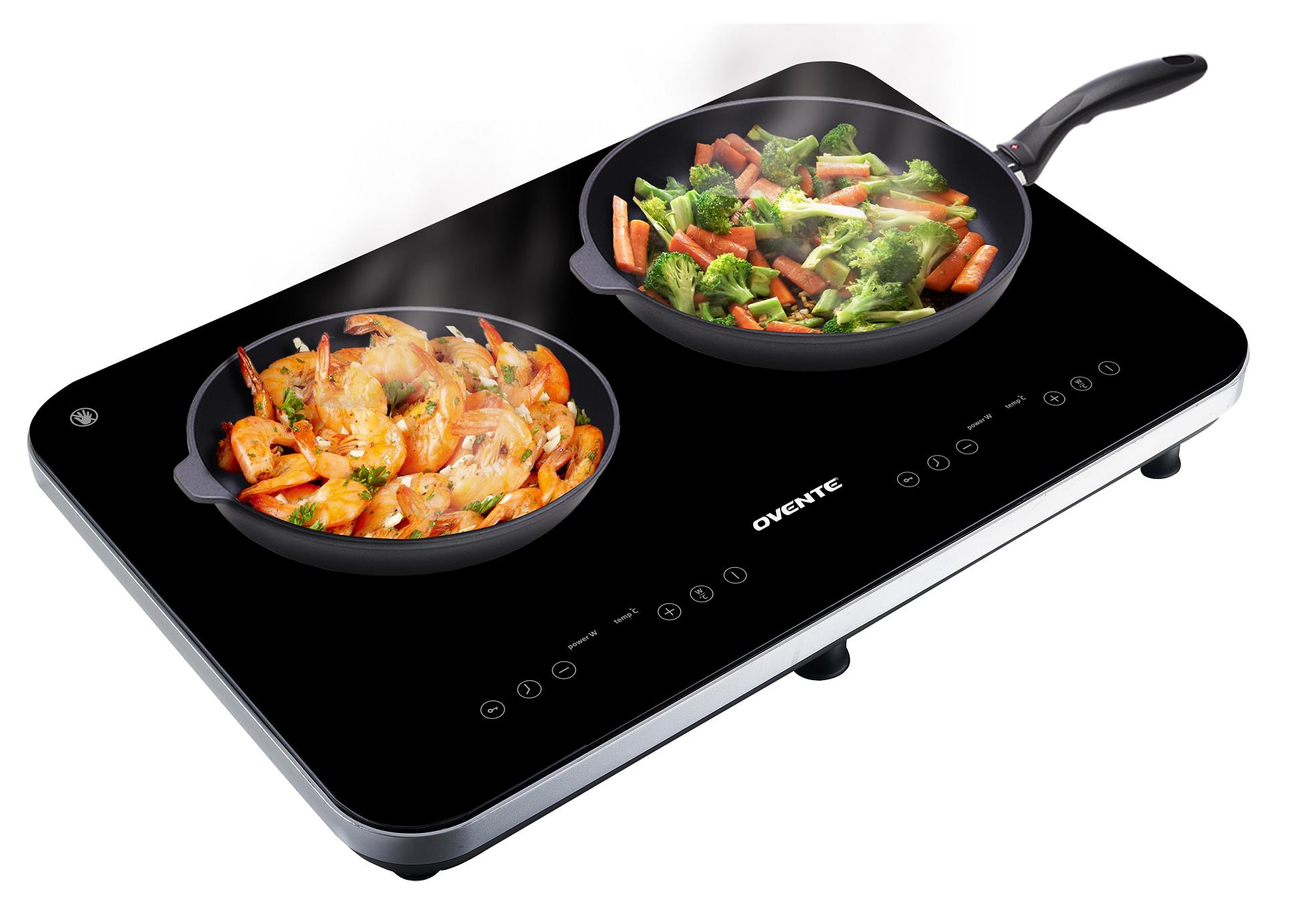
The manual describes a portable ceramic-glass double burner, 120 volts, 60 hertz and 1,800 watts. It is a countertop household arrangement, not an inset cooktop or outdoor appliance: Ovente’s instructions explicitly say not to use it outdoors. That matters for anyone drawn to “portable” as a camping feature. The product can provide an extra cooking surface indoors where an appropriate outlet and clear, level counter are available; the manual does not support treating it as an outdoor stove. Its one-year warranty also excludes commercial-use damage, although the manual does not explicitly state the appliance’s intended commercial-use category.
Two cooking zones share one 1,800-watt ceiling
Two zones are useful only if the power tradeoff suits the meal. The manual says that when the requested settings across both burners exceed 1,800 watts, power is adjusted between them. Its examples are unusually concrete: one burner at 1,800 watts leaves zero for the other, while 1,300 watts on one side leaves 500 watts on the other. In contrast, two lower selections can run without adjustment when their combined demand stays below the stated ceiling. So a shopper who only needs a second pan at a moderate setting might find the manual’s arrangement understandable; a cook who needs both burners to deliver their separate maximums simultaneously should rule it out. The manufacturer does not give a separate maximum for the right zone, so this assessment does not infer a symmetric zone rating from the illustration.
The power control lists eight settings: 100, 300, 500, 700, 900, 1,100, 1,300 and 1,800 watts. A second menu lists eight temperature setpoints from 140°F to 465°F. Those are two control modes, not a promise that a particular pan or food will stay at a laboratory-measured temperature. The documented temperature values are not evenly spaced, so a buyer requiring a specific maximum step between settings cannot safely treat the menu as a regular increment scale.
Timer, pan fit and daily handling
The manual documents a countdown timer adjustable from one minute to three hours, with the appliance shutting down when the programmed interval ends. It also describes a control-panel lock and automatic cookware detection. If the appliance is switched on without compatible cookware, an E1 code and a beeping warning precede shutdown. These are useful operating details, not evidence that the cooktop can be left unattended. The manual separately cautions against heating empty cookware and tells the user to keep the controls and appliance dry.
Cookware is a real limitation. Ovente says the cooktop needs magnetic induction-compatible cookware and lists cast iron, enameled iron or steel, and magnetic stainless steel as suitable types. It says aluminum, ceramic, copper, glass and Pyrex will not work. Its stated cookware-diameter window is 4.75 to 8 inches. The manual does not clarify whether those figures are pan-top or base diameters, however, so they should not be represented as a confirmed base-fit range. If the exact smallest pan base you need is essential, the documentation does not settle that requirement.
Who should use this record—and what to compare instead
This model note is most useful to someone identifying an older Ovente unit, checking its power-sharing behavior, or deciding whether an already-owned compatible pan belongs on it. It is not a fit for someone seeking a verified current offer, documented color-specific package, outdoor cooking unit, or two independent peak-power zones. Its manual provides more operating detail than a title-only old listing, especially the combined-power examples, but does not supply dimensions, weight, cord length, a circuit-amp figure, a separate per-zone maximum, or an exact pan-base range.
For a present-day purchase, compare current dual-zone models by their same-plan combined output, minimum pan-base requirement and timer behavior rather than by zone count alone. In this library, the Duxtop 8620BI/BT-K35 is a current-reference double-zone alternative with a documented five-inch minimum pan base and a 180-minute timer; its own 1,800-watt combined limit is also important, so it is not a solution when two zones must reach their separate maxima together. Read that model’s exact assessment before deciding whether its documented limits fit your cookware and cooking routine. The BG62B remains here as a clearly labeled reference only, with no implied current stock or seller match.
Evidence limits worth keeping in view
Ovente’s official manual filename supplies the BG62B identity link, while the cover and electrical page use BG62 Series and BG62. Because Ovente does not publish a current BG62B product page in its checked U.S. category or search, this reference does not fill in finish, package, dimensions or availability from other sellers. The manual’s image is a manufacturer-supplied family illustration; it is not a hands-on photograph, and the maker does not label it as a photograph or rendering. Those caveats are small but practical: they keep a helpful old-model reference from turning into an unsupported buying claim.
Key details at a glance
| Simultaneous cooking zones | 2 |
|---|---|
| Built-in installation documented | No |
| Documented placement options | countertop |
| Selectable power modes | 100 / 300 / 500 / 700 / 900 / 1100 / 1300 / 1800 W |
| Lowest selectable power mode | 100 W |
| Maximum listed power | 1800 W |
More specifications and setup details
| Listed voltage | 120 V |
|---|---|
| Listed manufacturer's warranty term | 1 year |
| Temperature Mode minimum | 140 °F |
| Temperature Mode maximum | 465 °F |
| Temperature settings | 8 |
| Countdown timer maximum | 180 min |
| Listed supply voltage | 120 V |
| Shared output between zones | Yes |
| Maximum combined power across active zones | 1800 W |
| Left zone maximum when used alone | 1800 W |
| Independent maximum wattage on both zones | No |
Use the exact model’s instructions for operating limits, supplied equipment and version differences.
Paper, software and setup details
Cookware fit and manual discrepancy
Manual gives a 4.75–8 in cookware diameter range, not a confirmed pan-base interval; cookware base fit remains unknown.
Sources for this assessment
Choose for the cooking setup you will use.
Compare exact model controls, zone count, pan fit and operating limits—not only headline wattage.