
Your needs, this model
Does it fit your priorities?
Will one induction pan at a time meet your routine?
Yes. ID1350 has one induction zone; if two pans must heat simultaneously, use a dual-zone requirement and exclude it.
Explore this need in the finder →Is a separate temperature-preset mode useful, without requiring a food probe?
The ID1350 manual lists eight Temperature setpoints separately from its eight Power wattage settings. It does not list a wired probe or food-internal endpoint; if that is essential, exclude ID1350.
Explore this need in the finder →Do you need a documented three-hour or longer auto-off countdown?
The booklet gives the general countdown a one-minute to three-hour range. A longer timer requirement is not met; the 300 W setting labelled Keep warm is not a separate long timer.
Explore this need in the finder →Will pans within the manual’s 4.75–8 inch cookware-diameter guidance be enough?
Yes for the stated cookware diameter range, with an important distinction: those numbers do not establish the magnetic-base diameter. A required base-size fit remains unknown.
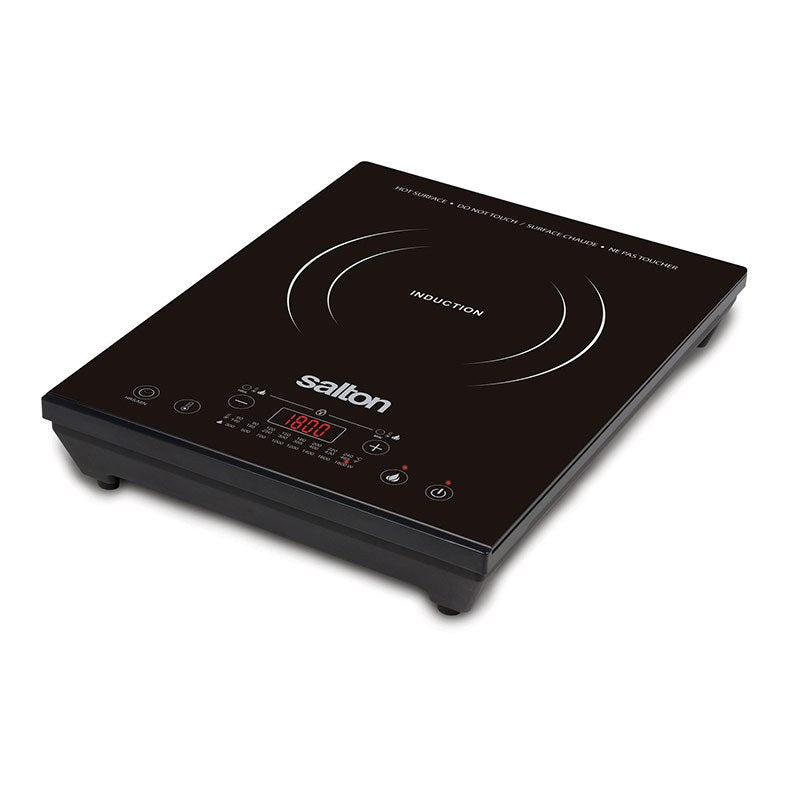
Explore this need in the finder →Salton’s ID1350 is a one-zone countertop induction cooktop whose clearest advantage over the company’s ID1880 is a higher listed maximum—1,800 watts rather than 1,500—plus selectable lower power steps. This is a source-based assessment of the exact ID1350 product page, the page-linked image, and the Salton-authored 12-page booklet marked ID1350, not a hands-on or measured performance test. The exact product page identified model ID1350 and UPC 061283107145 and displayed “In stock, ready to ship” when checked on October 24, 2026; that is a dated listing observation, not a lasting availability promise.
Power and temperature are separate ways to steer one burner
The ID1350 is for one pan at a time. Its manual separates Power from Temperature instead of treating them as one scale. Power mode offers eight listed wattage steps: 300, 500, 700, 1,000, 1,200, 1,400, 1,600 and 1,800 W. Temperature mode offers eight discrete settings from 140°F to 465°F: 140, 195, 250, 300, 355, 400, 430 and 465°F. Salton’s product page also lists a total power range of 300–1,800 W and temperature settings from 140–465°F.
That distinction helps match control style to the job. Choose a power level when you want to control the amount of energy delivered, such as bringing water to a boil or browning; choose a temperature preset when the booklet’s cooking-temperature cycle is more useful. These are controls and setpoints, not independently verified pan-surface readings. The model has no documented food probe, so it cannot replace a probe-based internal-temperature endpoint. Someone who specifically wants that capability should compare the ID1880 instead, while accepting its lower listed maximum output.
Timer, detection and lock are practical boundaries
The booklet documents a general auto-off countdown from one minute through three hours. When the chosen time expires, the cooker beeps and turns off. The manual also describes pot detection: if suitable cookware is absent or removed, E1 appears, the appliance beeps for about 30 seconds and shuts down. That is a cookware-detection behavior—not a guarantee that every pan size will be recognized. The control-panel lock blocks setting changes after you have chosen a mode and level; the On/Off control remains available. There is no documented Pause control or separate dedicated Keep Warm button. The 300 W power step is labelled “Keep warm” in the manual’s table, but that is not the same thing as a one-touch warm shortcut.
For a household routine built around a countdown of three hours or less and one pan, the documented controls are straightforward. If you need a second simultaneously heated zone, a longer documented general timer, a food probe, or a particular hold/pause feature, treat those as separate requirements. The three-hour limit is the normal countdown; do not infer a longer run from the 300 W “Keep warm” label.
Cookware dimensions are unusually explicit—but not a base measurement
Induction requires a magnetic, flat-bottom pan. The manual recommends cookware from 12 cm (4.75 inches) through 20 cm (8 inches) in diameter. It warns that cookware larger than the circular guide can have an inconsistent heating pattern outside the guide. This gives a useful upper pan-size boundary, but the manual says “cookware diameter”; it does not identify those figures as the magnetic base diameter. Its minimum usable magnetic base is therefore unknown. Measure the flat bottom separately if small-pan detection matters; a pan’s rim measurement cannot prove base compatibility.
The exact booklet also warns against heating an empty pan, calls for a dry, level, stable surface and says to unplug before cleaning. Although the product page uses “cool touch” language, the manual warns against touching hot surfaces. Induction heats the cookware, and the hot cookware can in turn warm the glass. Let the surface cool before wiping it, and do not treat this as a burn-proof top.
Outlet, placement and who should pass
The manual directs the user to a 120 V outlet and calls the plug polarized. It does not establish the exact NEMA subtype, cord length, circuit-sharing permission or a dedicated-circuit requirement. The matcher therefore treats voltage as documented but leaves plug subtype and cord length unknown; an essential exact-plug or cord-length requirement should not be waved through. The booklet says household use only and explicitly says not to use the appliance outdoors, despite the product page’s broad examples of camping and outdoor gatherings. Follow the more restrictive manual: “portable” does not establish weather protection or outdoor suitability.
ID1350 is a sensible shortlist candidate when one induction pan, a selectable 300–1,800 W range, distinct temperature presets, an auto-off timer up to three hours and cookware around the manufacturer’s stated size band fit the job. It is a poor match when two zones, an included probe, a specific NEMA plug, a small magnetic base, outdoor operation or a larger pan is essential. Its advantage is not a claim of faster real-world cooking; it is the documented higher nameplate maximum and clearer selectable power range. Check the exact model marking and pan base before buying, and compare probe-equipped alternatives if your cooking endpoint depends on internal-food temperature.
Key details at a glance
| Simultaneous cooking zones | 1 |
|---|---|
| Built-in installation documented | No |
| Selectable power modes | 300 / 500 / 700 / 1000 / 1200 / 1400 / 1600 / 1800 W |
| Lowest selectable power mode | 300 W |
| Maximum listed power | 1800 W |
| Included wired food probe | No |
| Listed voltage | 120 V |
| Dedicated Keep Warm shortcut | No |
| Temperature Mode minimum | 140 °F |
| Temperature Mode maximum | 465 °F |
| Temperature settings | 8 |
| Countdown timer maximum | 180 min |
| Listed supply voltage | 120 V |
| Cooktop finish | Black |
| Zone heating technologies | induction |
Use the exact model’s instructions for operating limits, supplied equipment and version differences.
Paper, software and setup details
Cookware fit and manual discrepancy
The manual requires a compatible magnetic, flat bottom. It recommends cookware diameter from 12 cm (4.75 in) through 20 cm (8 in), warning that cookware extending beyond the circular guide can heat inconsistently outside that guide. Those are cookware-diameter figures, not confirmed magnetic base diameters; minimum_pan_base_diameter_in remains unknown.
Electrical and placement note
The model-specific manual instructs connection to 120 V and says the plug is polarized. NEMA subtype is unknown. The booklet states household use only and says do not use outdoors, despite broader examples in the page marketing copy; outdoor operation is excluded.
Sources for this assessment
- Salton Portable Induction Cooktop, 1800W with 8 Temperature Settings, model ID1350
- Salton Product Manuals model index listing Portable Induction Cooktop ID1350
- Portable induction cooktop, Salton Instruction Booklet, model ID1350, 12 pages
- Salton current Cooktops collection JSON, page 1
- Salton current Cooktops collection JSON, page 2 pagination check
Choose for the cooking setup you will use.
Compare exact model controls, zone count, pan fit and operating limits—not only headline wattage.