
Your needs, this model
Does it fit your priorities?
Do you need two induction pans heating at the same time?
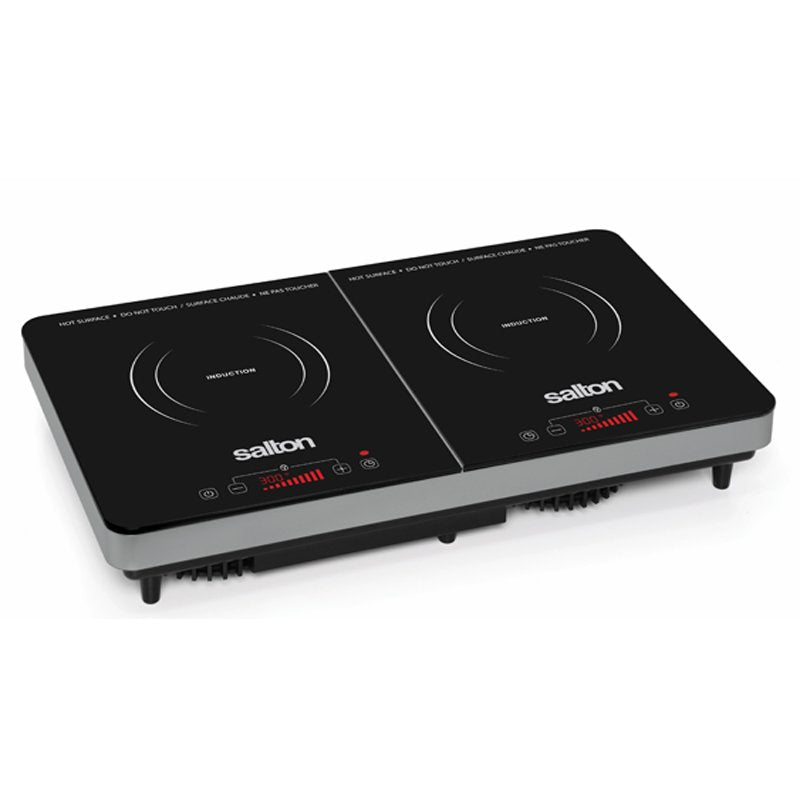
ID1487 has two induction rings and a repeated control group in its exact image and booklet diagram. The control layout fits a dual-zone plan, but its current sale status is unresolved, so use it as an identification reference rather than an available purchase.
Explore this need in the finder →Is a published wattage maximum for each zone or a shared power budget essential?
No per-zone or combined wattage cap is documented. The product page lists 300–1,800 W for the cooktop, but not whether those watts are shared; do not treat the range as proof that both zones can reach their maxima together.
Explore this need in the finder →Do you need a separate pan-temperature mode with explained settings?
The page advertises a temperature range, but the exact booklet describes cooking levels without explaining a separate temperature mode or its setting steps. If that distinction is essential, this model's documentation does not confirm it; Salton ID1350's booklet is clearer about separate modes, but it has one zone.
Explore this need in the finder →Would the manual's three-hour countdown and 4–10-inch cookware range work?
The exact booklet supports a one-minute-to-three-hour auto-off timer and 4–10-inch cookware diameter. It does not equate pan diameter with magnetic-base width, so a must-have small base measurement remains unknown.
Explore this need in the finder →Must the exact plug subtype or outdoor use be confirmed?
The booklet identifies 120 V and a polarized plug, but not a NEMA subtype; it also says not to use outdoors. A precise plug requirement or outdoor plan is not established.
Explore this need in the finder →Salton’s ID1487 is the company’s portable double-induction cooktop: two glass cooking rings with a control group at each side. Its strongest reason to consider it is simple—two compatible pans can sit on the unit rather than taking turns on a one-zone appliance. This is a source-based assessment of Salton’s exact model page, its product-page-linked image, and the Salton-authored 10-page booklet marked ID1487, not a hands-on or laboratory test. The exact page identifies one variant, SKU ID1487 and UPC 061283108562. Salton’s pages have shown conflicting availability states, so check the exact offer rather than treating an old status as a promise.
Two zones are the meaningful difference
The top view and the booklet’s diagram show two marked induction zones and repeated front controls. That layout is more useful than a single burner when a meal needs, for example, a pot and a pan heating at once. The manual’s operating instructions describe selecting a cooking level and using the timer and lock controls; they do not give a detailed dual-zone power table. Salton’s product page lists a 300–1,800 W range, but does not say whether 1,800 W is a shared ceiling, the maximum on one side, or an output each side can deliver simultaneously. There is no documented power-sharing rule or separate left/right maximum. Don’t choose this model on the assumption that both pans can receive peak power together.
Check the advertised controls against the booklet
The product page advertises eight temperature settings from 140°F to 465°F, plus Pause and Keep Warm. The exact booklet instead describes cooking-level indicator lights, On/Off, adjustment, a timer and a control-panel lock; it does not explain a separate temperature mode or how the named Pause and Keep Warm functions work. The listing and manual may describe different revisions or use condensed marketing language, but that bridge is not resolved by the sources reviewed here. A shopper who needs a particular setpoint mode, dedicated warm shortcut or Pause behavior should obtain the manual for the exact unit before relying on it. The displayed levels are not a measured pan-surface temperature, and no food probe is documented.
Timer, lock and pan detection are better documented
The booklet documents a general auto-off countdown from one minute through three hours. At the end, the cooktop beeps and shuts off. Its control-panel lock blocks setting and timer changes after setup; the On/Off button remains available. If compatible cookware is absent or lifted away during cooking, the display shows E1, the unit beeps for about 30 seconds and shuts down. These protections help explain ordinary use, but they do not mean the cooktop should be left unattended or that every pan will be detected.
The manual recommends a flat, magnetic base and says cookware should measure 4–10 inches in diameter. A fridge magnet that holds to the pan bottom is its suggested compatibility check. Larger cookware can extend past a marked zone and heat inconsistently. Those dimensions describe cookware diameter, not the size of the magnetic base; the minimum magnetic-base measurement remains unknown. If you rely on a small moka pot or other narrow-bottom vessel, test that exact pan rather than treating its rim width as proof of compatibility.
Countertop and electrical boundaries
The booklet calls for a 120 V outlet and identifies a polarized plug, but it does not name a NEMA subtype, cord length, circuit-sharing rule or required circuit amperage. An exact 1-15P or 5-15P requirement therefore cannot be confirmed from the documents. The instructions also specify household use and say not to use the appliance outdoors, despite broad marketing examples for portable cooking. Keep it indoors on a dry, level surface, avoid empty cookware, and keep flammable material clear of the operating area. The glass can become hot from the pan; wait for it to cool before cleaning. Built-in installation is not documented.
Who should shortlist it—and who should wait
Functionally, ID1487 is aimed at someone who wants two induction positions on a portable countertop unit and uses compatible flat pans within the booklet’s size range. It is not a fit for a required 240 V connection, outdoor cooking, an essential published per-zone wattage, or a must-have control behavior that the exact booklet does not establish. Its current exact offer is not treated as purchase-eligible while Salton’s canonical page reports it sold out and the alternate page state conflicts. The review remains useful for identifying the model, but it should not be presented as an available buy.
If one pan at a time is enough, compare Salton’s ID1350: its booklet explicitly lists separate Power and Temperature modes and their settings, so the control limits are clearer, but it is a single-zone product. If two pans are essential, compare currently offered dual-zone models whose manuals state their combined and per-zone output. ID1487’s two-ring layout is a genuine functional distinction; the unresolved power and control details are reasons to verify the exact revision, not details to fill in by guesswork.
Sources: Salton’s exact ID1487 page, the Salton manual index, and the Salton-authored ID1487 instruction booklet. The manual PDF is hosted on a document CDN; the booklet cover identifies ID1487.
Key details at a glance
| Simultaneous cooking zones | 2 |
|---|---|
| Built-in installation documented | No |
| Lowest selectable power mode | 300 W |
| Maximum listed power | 1800 W |
| Listed voltage | 120 V |
| Temperature Mode minimum | 140 °F |
| Temperature Mode maximum | 465 °F |
| Temperature settings | 8 |
| Countdown timer maximum | 180 min |
| Listed supply voltage | 120 V |
| Cooktop finish | Black |
| Zone heating technologies | induction / induction |
Use the exact model’s instructions for operating limits, supplied equipment and version differences.
Paper, software and setup details
Cookware fit and manual discrepancy
The booklet recommends suitable flat-bottom ferrous cookware and says a magnet should stick to the pan bottom. It specifies cookware diameter from 4 to 10 inches; these are not minimum magnetic-base dimensions. It warns that cookware extending beyond the zone guide may heat inconsistently.
Electrical and placement note
Manual says household use only and do not use outdoors. The product page's broad portable-use examples do not override that instruction. Two-zone countertop use is documented; built-in placement is not.
Sources for this assessment
Choose for the cooking setup you will use.
Compare exact model controls, zone count, pan fit and operating limits—not only headline wattage.