
Your needs, this model
Does it fit your priorities?
Will one compatible flat-bottom pan at a time meet your routine?
ID1948 has one induction zone. The booklet guides 4–10-inch cookware diameter and requires a magnetic, flat base; if two pans need heat simultaneously, choose a dual-zone need instead.
Explore this need in the finder →Do you want separate cooktop Temperature presets, rather than an internal-food probe?
The manual lists eight Temperature settings distinct from its eight Power levels. It documents no wired food probe; an essential probe requirement should exclude this model.
Explore this need in the finder →Is a three-hour auto-off countdown sufficient?
The exact booklet sets the general countdown from one minute to three hours. It does not document a longer timer or a separate probe-hold routine.
Explore this need in the finder →Will pans no larger than the manual-guided 10-inch diameter fit?
The booklet recommends cookware between 4 and 10 inches in diameter. Those figures do not confirm a minimum magnetic base size, and a larger essential pan is outside the stated band.
Explore this need in the finder →Is the stated 1,500 W maximum sufficient without requiring a wattage table for every Power level?
Salton lists 1,500 W maximum, but the exact manual gives no per-level wattage table for its eight Power levels. A 1,500 W maximum floor is documented; a higher floor or exact low-step wattage is not.
Explore this need in the finder →Salton’s ID1948 is a one-zone countertop induction cooktop with a separate Temperature mode and a three-hour auto-off timer. Its appeal is a familiar flat-pan setup with preset temperature choices rather than a special vessel, second burner or wired food probe. This is a source-based assessment of Salton’s exact model page, its one-variant SKU/UPC record, the page-linked image and the Salton-authored ID1948 booklet—not a hands-on or measured performance test. The product page identified model ID1948 and UPC 061283114761 and displayed “In stock, ready to ship” when checked on October 25, 2026; stock can change.
Eight temperature settings are not a food probe
The exact booklet describes two ways to control this single cooking zone. Power mode has eight numbered levels, but the manual does not give a wattage for each one. Salton lists 1,500 W as the cooktop’s maximum on its product page; that rating should not be used to invent the lower Power steps or predict cooking times. Temperature mode is separate: the booklet lists eight Fahrenheit setpoints—140, 195, 250, 300, 355, 400, 430 and 465°F—and corresponding Celsius choices from 60 to 240°C. It says the unit cycles on and off to maintain the selected cooking temperature, but does not say exactly what is sensed or establish calibrated pan-surface accuracy.
That distinction matters if you are comparing models. ID1948 can suit a cook who wants its stated temperature presets, but it does not have an included probe or a verified food-internal temperature endpoint. If you need the appliance to read food temperature and stop or hold based on that measurement, Salton’s probe-equipped ID1880 is the closer model family, though that adds a different control routine and its own source limits. A digital number on ID1948 is not evidence of a probe.
Timer and lock: useful, bounded controls
The booklet documents a one-minute-to-three-hour countdown. At the end, the cooktop beeps and shuts off. The “Set & Lock” control locks changes to the power, temperature and timer settings; the On/Off button remains functional. There is no Pause function, included food probe, separate probe-hold mode or documented one-touch Keep Warm shortcut. If a pause button, a food-temperature stop or a countdown longer than three hours is essential, those are genuine reasons to keep looking rather than assume a timer or temperature preset covers the need.
Cookware detection also has practical consequences. The manual says a missing, unsuitable or removed pan can trigger a roughly 30-second beep, E1 and automatic shutoff. That tells you the cooker has a detection response, not that every pan will be recognized. Induction still depends on a magnetic, flat bottom and correct placement; the booklet advises centering cookware within the printed guide and never heating an empty pan.
Check the pan, not just the glass ring
ID1948’s manual gives a cookware-diameter range of 4 to 10 inches. It names cast iron, enameled steel and magnetic stainless steel as compatible examples, and says aluminum, copper, ceramic, glass or Pyrex cookware will not operate unless its base has suitable magnetic material. A magnet on the flat bottom is the booklet’s suggested quick check. The 4–10-inch figures are cookware-diameter guidance, not a measured minimum magnetic base diameter; the latter remains unknown. If your smallest pan barely covers the ring, verify its base and the manufacturer’s requirements rather than treating an outside rim measurement as proof of detection.
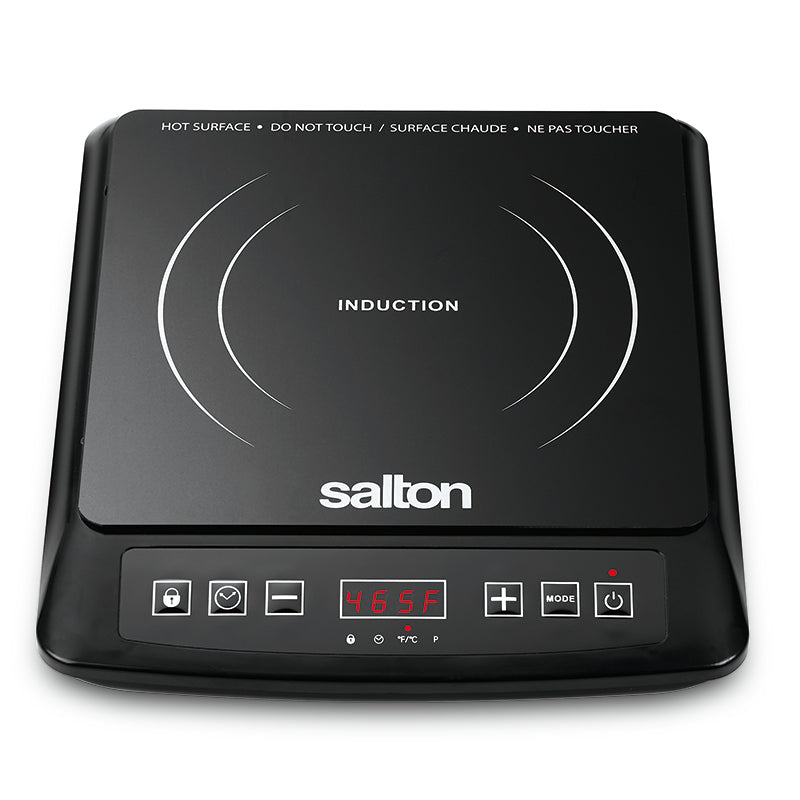
The product image shows one black glass cooking area and a front control strip, which is consistent with the one-zone ID1948 booklet cover. Salton does not say whether this gallery image is a photograph, rendering or composite. Despite general “cool touch” promotional wording on the product page, the booklet carries a hot-surface warning. The pan heats, and it can warm the glass underneath; let the unit cool before cleaning. The manual calls for a dry, level surface, household use only and explicitly says not to use it outdoors.
Who it suits—and who should pass
This is a reasonable shortlist candidate if one standard pan at a time is enough, your cookware falls within the booklet’s size guidance, 1,500 W maximum is adequate, and you like a separate set of eight Temperature choices plus a timed shutoff. Compared with the Salton ID1350, ID1948 has the same broad one-zone/preset concept but a lower listed maximum; ID1350’s manual supplies its individual Power-mode wattages, while ID1948’s does not. If wattage at each level is important, do not infer that table for ID1948. If two pans must heat simultaneously, a dual-zone model is the right category instead.
For electrical fit, the booklet instructs connection to a 120 V outlet and identifies a polarized plug. It does not identify an exact NEMA subtype, cord length or circuit-sharing permission. Do not choose it on a guessed plug type or adapt it to a different outlet. The maker’s current page and its exact variant both indicated an active listing when checked, but the precise offer and stock should be rechecked before purchase. Read the manual supplied with the unit and confirm pan-base compatibility; this assessment does not substitute for a safety or performance test.
Sources: Salton’s exact ID1948 product page, its product-manual index and the Salton-authored ID1948 instruction booklet hosted on The Home Depot’s document CDN.
Key details at a glance
| Simultaneous cooking zones | 1 |
|---|---|
| Built-in installation documented | No |
| Maximum listed power | 1500 W |
| Included wired food probe | No |
| Listed voltage | 120 V |
| Dedicated Keep Warm shortcut | No |
| Temperature Mode minimum | 140 °F |
| Temperature Mode maximum | 465 °F |
| Temperature settings | 8 |
| Countdown timer maximum | 180 min |
| Listed supply voltage | 120 V |
| Cooktop finish | Black |
| Zone heating technologies | induction |
Use the exact model’s instructions for operating limits, supplied equipment and version differences.
Paper, software and setup details
Cookware fit and manual discrepancy
The manual requires suitable magnetic cookware with a flat bottom, gives cast iron, enameled steel and magnetic stainless steel as examples, and recommends 4–10 inches of cookware diameter. These are cookware-diameter values, not a measured magnetic-base diameter; minimum_pan_base_diameter_in remains unknown. It advises centering pans within the printed guide and not heating empty cookware.
Electrical and placement note
Use only the 120 V polarized-plug arrangement described in the model booklet. The exact NEMA plug subtype is not identified; no outlet amperage, extension-cord length, or shared-circuit permission is inferred. The booklet says household use only and do not use outdoors.
Sources for this assessment

Choose for the cooking setup you will use.
Compare exact model controls, zone count, pan fit and operating limits—not only headline wattage.