
Your needs, this model
Does it fit your priorities?
Do two pans need to heat at once?
Yes. The exact PKSTIND48 manual and product page describe separate left and right induction zones.
Explore this need in the finder →Is there a dedicated Warm shortcut?
Yes. The exact manual lists Warm as a function, fixed at 140°F.
Explore this need in the finder →Does it prove both zones can deliver their separate peak wattage at the same time?
No. The product page advertises 1,800 W × 2, but the manual and 120 V/15 A supply do not verify a simultaneous 3,600 W capability.
Explore this need in the finder →NutriChef’s PKSTIND48 is a wide, two-zone countertop induction cooktop with a separate control area for each side. It suits the basic two-pan job—say, a small pot beside a skillet—better than any single-burner model in this family. Its manual lists Fry, Steam, Water and Warm functions and a temperature table, while the product page advertises 1,800 W for each element. The electrical and power claims do not line up cleanly enough to promise two full 1,800 W zones at once, so this is not the right choice if independent peak output is essential.
Two controls do not mean two full circuits
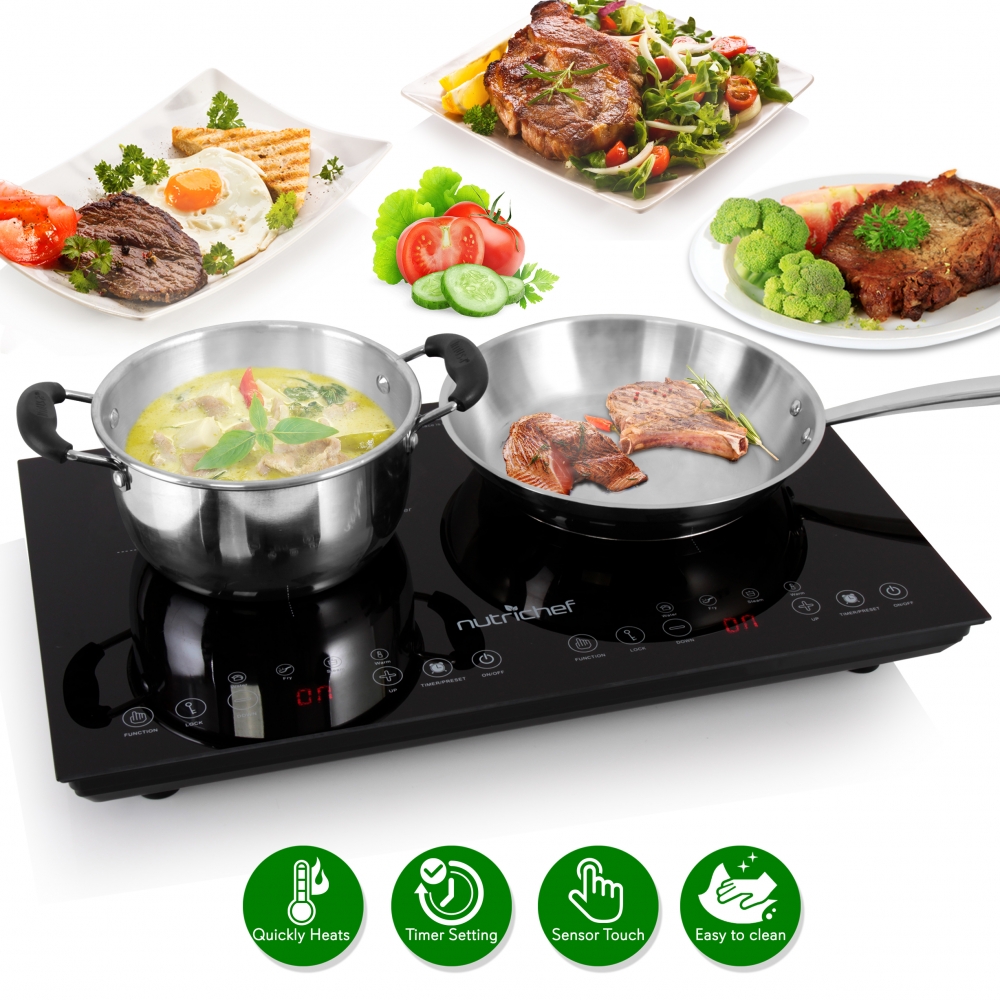
The product image shows a horizontal black-glass body with two marked circles and separate button/display groups. The Pyle page describes each zone at about 6.7 inches. Those circles are induction zones, not radiant hot plates: use a flat pan with a magnetic base, center it, and confirm the cookware matches the manual’s 12–26 cm diameter range. That converts to about 4.7–10.2 inches, but the manual does not define those endpoints as magnetic-base diameters. If pan fit is critical, ask the maker for a base-size limit rather than treating the circle graphic as a promise.
The documentation has a meaningful output wrinkle. The Pyle listing uses an “1,800 W x 2” description, while the exact manual’s power wording and its 120 V, 15 A supply instruction do not establish that both zones can draw that amount simultaneously. A 120 V, 15 A connection cannot be treated as proof of a 3,600 W household device. For this assessment the two-zone presence is confirmed, but combined maximum, per-zone limit and simultaneous full-power availability remain unknown. If your cooking plan depends on a measured two-zone peak, get written clarification before buying; do not infer it from two circles or from the marketing headline.
Temperature presets and Warm are not a measured hold
The manual’s selectable temperature points are 140, 210, 260, 300, 350, 390, 430 and 460°F. They are unevenly spaced, so a single “temperature step” is not accurate. The display indicates a chosen setting; it does not read the food or pan surface. The Warm function is a dedicated shortcut fixed at 140°F according to the instructions, not an indefinite hold or a substitute for a thermometer. The manual lists countdown behavior up to four hours for Fry and Water. Steam has a separate delayed preset limit up to 23:59, and Warm’s own preset limit is different again; those figures should not be confused with a four-hour countdown.
The zones use separate controls, which helps when one pan needs more attention than the other, but separate controls alone do not prove independent power delivery. Place only compatible pans on the glass; the manual warns not to run a zone with an empty pan and calls for at least 10 cm around the unit and an individual outlet rated at least 15 A. The product page lists a 4.9-foot cord and a body of roughly 14.2 by 23.6 by 2.6 inches. At 15.5 pounds, it is portable for storage or a temporary station, but much less nimble than a one-zone burner.
Who should choose it?
Pick the PKSTIND48 if two simultaneous pans, clearly separate controls and a one-touch Warm option suit your cooking—and if the unresolved output ceiling is acceptable. The PKSTIND49 is the more useful comparison: its manual explicitly says the two elements share a 1,800 W total, and its own manual also lists Warm. For a family of settings, the smaller PKSTIND26 stays single-zone but documents a low-fire preset and a higher 518°F point. Do not pick the 48 on the assumption that its “x2” headline solves a simultaneous high-heat requirement.
Let the cooktop cool fully before wiping the glass, unplug it before cleaning and keep the fan path free of grease or cloth. The original PKSTIND48 manual and Pyle exact-SKU page establish the functions and body format; no included pan is confirmed. The current page’s output phrasing remains in tension with the electrical limit, and live seller stock was not checked. Confirm the exact model code and delivered manual. See the Pyle PKSTIND48 listing and PKSTIND48 manual.
Use the exact model’s instructions for operating limits, supplied equipment and version differences. Manual cookware diameter is 12–26 cm; the lower bound is not stated as a magnetic-base minimum. Standard flat-bottom induction cookware is intended; exact minimum detectable base is unknown. Exact source states 120 V/60 Hz and an individual outlet of at least 15 A, with 10 cm clearance. Exact PKSTIND48 manual inspected. It documents two separately controlled zones, Fry/Steam/Water/Warm, nonuniform 140–460°F settings, a 4-hour countdown in specified functions, 120 V, at least 15 A and 10 cm clearance. Its power wording and the page’s 1,800 W × 2 claim do not establish simultaneous output.Key details at a glance
Simultaneous cooking zones 2 Built-in installation documented No Documented placement options countertop Body height 2.6 in Listed unit weight 15.5 lb Power-cord length 4.9 ft Listed voltage 120 V Listed manufacturer's warranty term 1 year Dedicated Keep Warm shortcut Yes Temperature Mode minimum 140 °F Temperature Mode maximum 460 °F Temperature settings 8 Countdown timer maximum 240 min Keep Warm shortcut target 140 °F Listed supply voltage 120 V Listed unit weight 15.5 lb Cooktop finish Black Zone heating technologies induction Paper, software and setup details
Cookware fit and manual discrepancy
Electrical and placement note
Manual-version differences
Sources for this assessment

Choose for the cooking setup you will use.
Compare exact model controls, zone count, pan fit and operating limits—not only headline wattage.